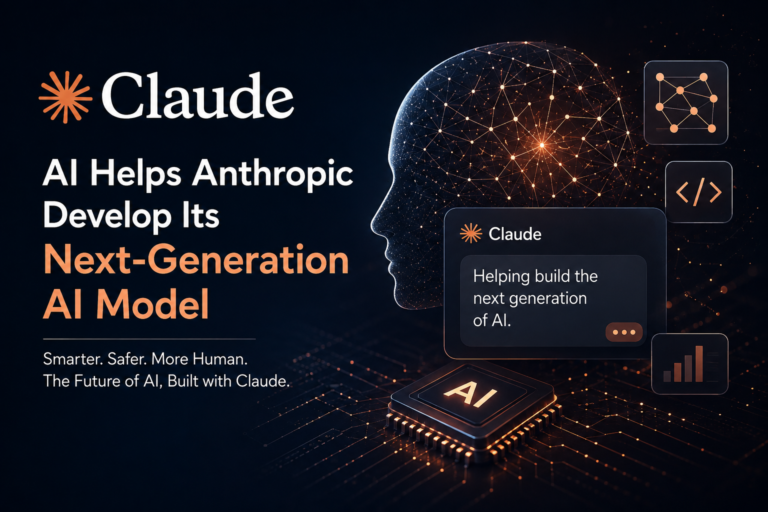
Claude AI Helps Anthropic Develop Its Next Generation AI Model
Over sixty percent of technical work at leading research labs now involves direct assistance from smart computer software. Anthropic is putting this concept into practice at an unprecedented scale. The research company relies heavily on its own model, Claude, to write code, test algorithms, and evaluate training data. This development method allows researchers to make rapid progress while keeping safety standards high. Claude AI helps Anthropic develop its next generation AI model by handling repetitive coding tasks, analyzing complex systems, and finding errors in training pipelines.
Building modern artificial intelligence requires billions of calculations and millions of lines of software code. Human engineers used to spend weeks writing basic scripts and checking raw text files by hand. Now, intelligent software assistants handle those routine tasks in a fraction of the time. The result is a faster, more reliable development cycle that produces superior tools for businesses and consumers.
How Claude AI Assists the Anthropic Engineering Team
Creating a frontier foundation model involves massive software infrastructure. Human engineers spend long hours setting up data pipelines, debugging cloud servers, and checking mathematical scripts. Claude acts as an active technical assistant for these research teams. It reviews code for syntax errors, suggests faster algorithms, and writes documentation for internal systems.
Engineers at Anthropic use Claude to write automated unit tests. Writing tests by hand is slow and can leave blind spots in the code. Claude generates hundreds of test scenarios within minutes, ensuring that every script works properly under extreme conditions. This automated verification catches software bugs before expensive training runs begin on server clusters.
The research team also uses Claude to debug distributed computing systems. Training giant neural networks requires thousands of specialized graphic processing chips working together across high speed networks. When a single chip encounters an error, Claude analyzes system logs to identify the exact cause quickly. Resolving hardware communication issues saves the company valuable computing time and financial resources.
The Mechanics of Recursive Model Improvement
Recursive improvement happens when a computer system assists in creating a more capable successor. Anthropic uses Claude to evaluate the logic and reasoning abilities of new experimental models. The current model asks challenging questions, grades the responses, and flags areas where the new model struggles. This immediate feedback loop helps engineers tune model parameters with high precision.
Data curation is another critical task where Claude proves its value. Training datasets contain billions of words gathered from public research papers, books, and code repositories. Raw data frequently contains duplicate passages, formatting errors, and low quality text. Claude scans these massive data collections, removes unusable content, and formats the remaining text for optimal learning.
The model also helps researchers write mathematical loss functions. These equations guide how the network adjusts its internal parameters during the training process. Claude analyzes experimental results from small test runs and proposes mathematical adjustments to improve learning efficiency. Engineers review these suggestions and apply the most promising ideas to larger training systems.
Creating Better Synthetic Data for Training
Human text on the public internet is finite, and researchers are quickly running out of fresh material. Creating high quality synthetic data is necessary to train smarter models. Claude generates structured practice problems across computer science, formal logic, and advanced mathematics. These synthetic examples provide rich learning material that helps new models develop stronger reasoning skills.
Quality control is essential when generating synthetic training material. Poorly written synthetic text can cause a learning model to repeat factual mistakes. Anthropic uses Claude to critique and score its own generated outputs before adding them to training sets. Only examples that pass strict quality and safety filters make it into the final dataset.
Synthetic data also helps balance representation across rare technical subjects. Specialized fields like quantum mechanics or obscure programming languages have limited open source material online. Claude writes detailed explanations and sample exercises for these technical topics. This targeted dataset generation ensures that the next generation system gains broad competence across difficult disciplines.
Automated Testing and Safety Checks
Anthropic is known for its focus on artificial intelligence safety and Constitutional AI principles. Safety research requires thousands of hours of adversarial testing, often called red teaming. Claude conducts automated red teaming by generating tough prompts designed to test system boundaries. It checks whether the new model refuses harmful requests while continuing to provide helpful answers.
Constitutional AI relies on explicit rules to guide model behavior during fine tuning. Claude evaluates candidate responses against these written rules, rewarding helpful answers and penalizing harmful ones. This automated evaluation process allows Anthropic to train safer models without relying entirely on human feedback teams. Automated oversight scales much better than manual review processes.
Model drift and safety failures are detected early through continuous automated testing. When a model updates its internal weights, unexpected changes in behavior can occur. Claude monitors output consistency across thousands of standard benchmark questions. If the new system shows signs of bias or reduced accuracy, researchers get alerted right away.
Traditional AI Development Compared to Claude Assisted Development
The shift toward artificial intelligence assisted development changes how engineers spend their working hours. The table below outlines how traditional development methods compare to modern automated workflows.
| Development Task | Traditional AI Development | Claude Assisted Development |
|---|---|---|
| Writing Test Cases | Engineers write tests manually | Claude generates hundreds of test suites |
| Data Cleaning | Basic rule filters and human spot checks | Claude filters context and cleans datasets |
| Bug Detection | Manual log reviews after system crashes | Claude scans logs to pinpoint errors |
| Safety Audits | Limited human red team reviews | Continuous automated red teaming by Claude |
Why This Feedback Loop Speeds Up Innovation
Speed is a major advantage in artificial intelligence research today. Traditional development pipelines require human programmers to write every script and check every dataset by hand. With Claude assisting at every stage, research cycles that once took months now take weeks. Engineers spend their time designing overall architecture while Claude handles the execution details.
Running experiments around the clock gives Anthropic a massive operational advantage. While human researchers rest, Claude continues to analyze test logs and generate training examples. Morning meetings begin with fresh data summaries and clear recommendations prepared by the model. This continuous progress prevents engineering bottlenecks and keeps development moving forward.
Cost efficiency is another major benefit of using an automated assistant. Training massive frontier models costs tens of millions of dollars in electricity and cloud computing time. Catching a code bug early prevents wasted training runs on expensive server clusters. Using Claude to verify code integrity saves substantial computing budgets.
Keeping Humans in Control of the Loop
Self improving software raises natural questions about human oversight and safety. Anthropic maintains strict human in the loop policies across all its research programs. Claude provides suggestions, generates data, and writes code, but human engineers approve all major decisions. No experimental code is deployed to live systems without human review and authorization.
Preventing negative feedback loops is a central priority for the research team. If an artificial intelligence model trains purely on its own unverified outputs, quality degrades rapidly over time. Researchers use diverse real world validation benchmarks to verify that model performance is genuinely improving. These external checks ensure that synthetic training creates real capability rather than hollow pattern matching.
Security protocols restrict Claude from modifying its own core safety parameters directly. The system cannot change its underlying constitution or bypass safety evaluations on its own. Human safety researchers maintain absolute control over the fundamental rules that govern model behavior. These boundaries keep the development process safe and predictable.
What the Next Generation Model Will Deliver
The upcoming model developed with Claude assistance will bring noticeable performance improvements for users. Advanced coding capabilities will allow the model to build complete software programs from simple descriptions. It will diagnose complex bugs across multiple file software projects with high speed. Programmers will be able to build advanced applications in a fraction of the usual time.
Complex reasoning and logic will see substantial upgrades in the new system. The model will solve difficult scientific problems and perform detailed multiple step calculations reliably. Researchers in biology, chemistry, and physics will use these capabilities to accelerate laboratory discoveries. Better reasoning makes the software a practical tool for serious academic research.
Tool usage and computer control will become smoother and more autonomous. The next model will interact with desktop software, run terminal commands, and browse web pages to finish assignments. Instead of just answering text questions, it will execute complex business workflows from start to finish. This capability turns the model into a capable digital worker for companies worldwide.
How Businesses Can Apply These Same Methods
Companies do not need to build frontier artificial intelligence models to benefit from these techniques. Any software team can use Claude today to automate daily coding, testing, and data tasks. Integrating Claude into your development pipeline will help your team ship software faster with fewer bugs.
Start by using Claude to write unit tests for your existing codebase. Point the model toward an untested software module and ask it to generate comprehensive test suites. This single practice improves software reliability without eating up developer time. Your engineering staff can focus on building revenue generating features instead of writing repetitive test cases.
Use Claude to clean and structure internal business data for analytics. Messy spreadsheets, unstructured customer emails, and disjointed PDF documents can be standardized quickly. Claude extracts relevant fields, verifies formatting, and prepares clean datasets for your business analytics tools. Having organized data allows your company to make better operational decisions.
Automate repetitive customer support documentation using intelligent summarization. Claude reads complex support tickets and drafts clear articles explaining how to fix common issues. This practice keeps your technical documentation fresh and helps support agents answer questions faster. Better documentation leads to happier clients and lower support costs.
Practical Questions About AI Assisted Model Creation
Many people wonder whether an artificial intelligence model can become smarter than its creators simply by writing code. The answer depends on data quality, compute resources, and algorithmic architecture. Claude helps optimize code and clean data, but human scientists still invent the underlying mathematical breakthroughs. Smart software accelerates human ingenuity rather than replacing it entirely.
Another common question involves the risk of models amplifying their own biases. If an AI generates training data containing biased views, future models might learn those biases. Anthropic avoids this problem by using explicit constitutional guidelines and diverse data sources. Strict verification checks ensure that synthetic data adheres to neutral and balanced viewpoints.
People also ask if AI assisted development makes human software engineers obsolete. In practice, engineers become far more productive when they work with intelligent coding assistants. Instead of spending hours typing standard boilerplate code, engineers act as project directors and system architects. Human creativity, product vision, and ethical judgment remain completely irreplaceable.
The Future Path of Artificial Intelligence Research
The partnership between human researchers and artificial intelligence models will grow even closer in coming years. As models become more capable, they will take over more complex parts of the research lifecycle. Future systems will propose new neural network architectures and design novel training algorithms. Human scientists will guide these systems toward solving humanity’s most pressing challenges.
Open communication about development methods helps build public trust in artificial intelligence. Anthropic shares research papers detailing how Constitutional AI and synthetic data training function. This transparency allows the broader scientific community to review findings, replicate tests, and improve safety standards. Collaborative research ensures that advanced technology develops in a safe manner for society.
Automated development pipelines will also lower the barrier to entry for smaller research labs. As AI assistants become more efficient, small teams will build specialized models that once required giant corporations. This democratization of technology will spark fresh competition and speed up scientific progress across the globe.
Summary and Call to Action
The development of next generation artificial intelligence is moving faster because Claude AI helps Anthropic develop its next generation AI model. By automating software testing, cleaning massive datasets, and performing continuous safety checks, Claude acts as a vital research partner. This recursive development approach produces more capable, reliable, and secure tools for everyone.
Start exploring how smart automation can improve your own daily workflows today. Try using Claude to write code, analyze data, and optimize your business processes. Experience the power of intelligent software assistance firsthand and prepare your organization for the future of technology.
About the Author