Etched AI Chip Startup Valuation Hits $40B: What It Means
The global artificial intelligence hardware market is projected to reach over three hundred billion dollars by the year twenty thirty. Tech companies and research laboratories are buying every processing chip they can find to power modern software. Nvidia currently sells the vast majority of these specialized graphics processors, but ambitious startups are rushing to challenge its dominance. Etched, a young computer chip company, is now reviewing incoming investment offers that value the business at over forty billion dollars.
This valuation surge comes just a few months after the startup raised seven hundred million dollars at a twenty one billion dollar valuation. Investors from top tier venture capital firms and global financial institutions are competing to secure equity in the company. Etched aims to transform how computer servers process language models by building custom hardware from the ground up. This detailed overview covers why investors are bidding billions, how the hardware works, and what it means for the future of computing.
What Is Etched and Why Is It Worth Forty Billion Dollars?
Etched is an American technology company that designs specialized microchips specifically to run artificial intelligence models. Most companies currently use general purpose graphics processors made by Nvidia to handle their daily computing workloads. While graphics chips work well for training large models, they consume massive amounts of electricity when answering user questions. Etched builds custom silicon chips dedicated purely to language processing, making them run faster and cheaper.
The company focuses on a process known as inference, which is the calculation that happens after a person types a prompt into an application. When millions of people use digital assistants simultaneously, server costs can reach billions of dollars each year. Etched claims its specialized processors can deliver answers many times faster than standard chips while using less power. Venture capitalists believe this specific hardware focus can capture a huge share of corporate infrastructure spending.
Incoming investment bids range from forty billion dollars from prominent Silicon Valley funds to fifty billion dollars from international groups. These fundraising discussions are still in early stages, meaning final terms and amounts may shift before deals close. Even so, the huge numbers prove that investors are desperate to find viable alternatives to Nvidia. Backers see hardware design as the most lucrative opportunity in the technology sector today.
The Fast Rise: From Ten Billion to Forty Billion in Months
The financial progress of Etched has broken records across the venture capital landscape. In July, the startup announced a three hundred million dollar funding round led by Sequoia Capital that valued the company at ten point three billion dollars. Just two months later in September, Etched secured seven hundred million dollars at a twenty one billion dollar valuation. That massive round was led by quantitative trading giant Jane Street alongside prominent tech investors.
Receiving fresh bids at forty to fifty billion dollars so quickly shows the immense momentum behind custom silicon. These consecutive funding rounds function like a single massive capital raise split into separate pricing stages. High valuation jumps allow early employees and founders to maintain substantial company equity while bringing in billions of dollars in fresh cash. Startup founders use this capital to buy expensive fabrication slots at semiconductor manufacturing plants.
Building physical computer chips requires enormous upfront capital before the first commercial product ships to customers. Creating test chips, buying advanced packaging materials, and booking cleanroom time costs hundreds of millions of dollars per production run. If Etched closes another major round near its current bids, the startup will secure more than three years of financial runway. This deep cash cushion allows engineers to focus on research and development without fear of running out of money.
Inference Versus Training: The Core Hardware Battle
To see why Etched attracts such massive valuations, one must look at how artificial intelligence models work. The lifecycle of any language model splits into two distinct phases called training and inference. Training involves feeding billions of web pages, books, and articles into a model so it learns grammar, facts, and logic. This process takes months of computing time and requires thousands of linked graphics cards running together.
Inference happens after the training phase is complete and the model goes live for the public. Every time a user asks a question, translates a sentence, or writes a computer program, the server performs inference calculations. While training happens only once every few months, inference happens billions of times every single day. As more software tools add smart features, global spending on inference is expected to surpass training costs significantly.
Nvidia graphics chips were originally designed to render three dimensional video games, making them flexible but power hungry. Because they must support many different types of math, graphics chips contain extra circuits that language models do not need. Etched strips away those unnecessary circuits to focus entirely on transformer architecture calculations. This dedicated design allows the chips to calculate word predictions with incredible speed and efficiency.
Why Jane Street and Wall Street Are Betting on Token Speed
Quantitative trading firms like Jane Street operate in financial markets where milliseconds can mean millions of dollars in profit or loss. These firms use complex mathematical algorithms to analyze stock prices, news headlines, and market trends in real time. If a trading algorithm can process incoming financial data faster than rival firms, it can execute profitable trades before prices shift. This extreme need for speed makes specialized hardware priceless on Wall Street.
Jane Street did not just invest hundreds of millions of dollars into Etched; it also signed on as an active customer. The trading firm took delivery of early hardware systems to test them inside its proprietary trading infrastructure. Etched announced that it had already secured more than one billion dollars in advance customer orders from major financial and technology firms. Having paying customers validate hardware performance gives venture capital backers immense confidence.
Token throughput is the primary metric used to measure inference performance in modern computing centers. A token represents a piece of a word or character that a computer reads and generates. Etched claims its chips can process more tokens per second at a fraction of the operating cost of existing graphics cards. For algorithmic traders and cloud providers, higher token speeds translate directly into higher profits and lower electricity bills.
Competing Directly with the Nvidia Monopoly
Nvidia currently controls more than eighty percent of the global market for artificial intelligence accelerators. Major cloud providers like Microsoft, Google, Amazon, and Meta spend tens of billions of dollars each quarter buying Nvidia server racks. This reliance on a single supplier creates long wait times and high prices for every tech company. The entire industry wants alternative hardware options to lower server costs and reduce supply risks.
Etched aims to break this monopoly by outperforming standard graphics processors on specific language workloads. While Nvidia builds versatile chips that can process computer vision, gaming, simulations, and text, Etched focuses purely on transformer algorithms. By dedicating every square millimeter of silicon to transformer math, the startup achieves higher processing density. This specialized hardware architecture provides a distinct performance advantage over general purpose chips.
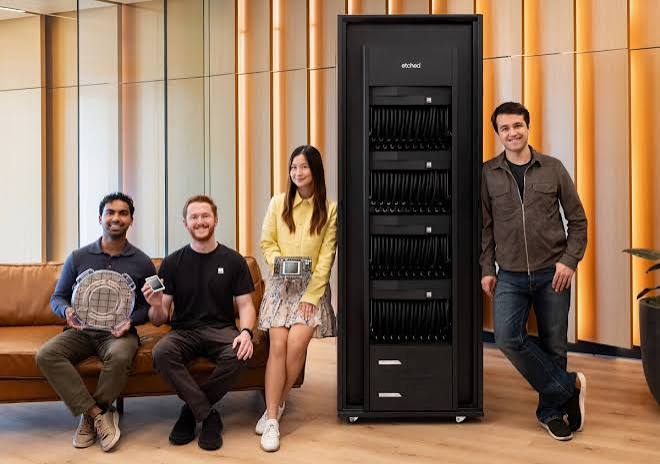
Challenging an industry giant requires more than just designing fast silicon; it requires building complete server racks. Etched is not just selling bare microchips to third party assemblers. The company designs the cooling systems, motherboards, power supplies, and networking switches needed to run entire server clusters. Delivering complete server systems makes it easy for enterprise data centers to adopt their technology quickly.
Attracting Elite Engineering Talent from Industry Giants
A semiconductor company is only as good as the engineers who design its silicon layouts. Designing microchips with billions of transistors requires rare expertise in electrical engineering, physics, and computer science. Etched has impressed industry analysts by recruiting heavily from top hardware companies across Silicon Valley. Approximately fifteen percent of the four hundred person workforce at Etched previously worked at Nvidia.
Luring veteran engineers away from established tech giants proves that the startup technical vision is credible. Experienced chip designers know the physical limits of current graphics processors and see the value in dedicated architectures. Engineers join Etched because they want to work on clean sheet hardware designs without corporate bureaucracy. High equity compensation packages funded by massive venture rounds also serve as a powerful recruiting tool.
The technical team also includes senior talent from other leading semiconductor firms like Intel, AMD, and Broadcom. This mix of experienced industry veterans and ambitious young researchers creates an intense, fast moving engineering culture. The company encourages rapid testing, allowing teams to iterate on chip designs much faster than legacy corporations. Having top tier engineering talent is the primary reason investors are willing to pay forty billion dollars for a young company.
Physical Infrastructure: Silicon Valley and Taiwan Facilities
Designing microchips on computers is only the first step; bringing them to physical life requires massive industrial infrastructure. Etched operates a modern ten megawatt data center located directly in Silicon Valley. This private computing facility provides the immense power and cooling needed to test chip prototypes and run simulation software around the clock. Having dedicated data center capacity prevents testing bottlenecks and accelerates hardware development.
The company has also established a permanent engineering facility in Taiwan to coordinate production with local supply chain partners. Taiwan is the global epicenter of advanced semiconductor manufacturing, home to Taiwan Semiconductor Manufacturing Company, known as TSMC. Etched manufactured its test chips at TSMC fabrication plants, proving that its digital blueprints could be turned into functioning silicon. Having an on site team in Taiwan ensures smooth communication with foundry technicians during mass production runs.
Securing production capacity at TSMC is one of the hardest challenges for any new hardware company. The world largest tech firms compete aggressively for limited cleanroom slots and silicon wafers. By raising billions of dollars in early funding rounds, Etched can place large advance orders and secure vital manufacturing capacity. Strong relationships with Asian manufacturing partners ensure that the company can scale deliveries to meet its billion dollar order backlog.
The Founders: From Harvard Classrooms to Silicon Valley
The story of Etched began inside an advanced mathematics lecture hall at Harvard University. Co founders Gavin Uberti and Chris Zhu met as students and quickly bonded over their shared fascination with computer architecture. They realized early on that general purpose graphics cards were poorly optimized for the massive language models that were beginning to emerge. They believed that dedicated hardware built purely for transformer models would eventually beat versatile graphics chips.
Robert Wachen, who was Uberti roommate at Harvard, joined the founding team to lead business operations and strategy. Recognizing the massive commercial opportunity ahead of them, the founders made the bold choice to drop out of Harvard and build the company full time. They moved to California, assembled a core engineering team, and began drafting their first custom silicon blueprints. Their youth, technical clarity, and relentless drive quickly attracted the attention of prominent investors like Peter Thiel and Sequoia Capital.
The founders maintain a hands on leadership style, working directly alongside engineering teams on technical problems. They have focused the entire company culture on speed, physical execution, and rigorous mathematical testing. Their ability to articulate complex hardware benefits to non technical investors has helped them raise more capital than almost any other hardware startup in history. Their journey shows how clear technical insight can disrupt massive global industries.
Comparing Etched Hardware with Traditional Graphics Processors
| Feature | Etched Custom Silicon | Traditional Nvidia Graphics Chips |
|---|---|---|
| Primary Focus | Dedicated purely to transformer inference | Versatile computing, graphics, and training |
| Power Consumption | Lower electricity use per processed token | Higher power draw due to extra general circuits |
| System Design | Full custom server systems and cooling | Modular graphics cards and server racks |
| Software Strategy | Streamlined software for transformer models | Broad CUDA ecosystem supporting all workloads |
| Target Customers | High frequency trading, enterprise AI clouds | Broad market, gaming, research, and cloud |
The Staggering Financial Cost of Custom Chip Development
Building custom computer chips is one of the most expensive business ventures on earth. A single tape out, which is the final design handoff to a semiconductor factory for physical printing, can cost over fifty million dollars. If an engineering team makes a single microscopic error in the blueprint, that money is lost, and the team must start over. The high cost of failure creates a massive barrier to entry that keeps small competitors away.
Beyond chip manufacturing, building complete server systems requires purchasing expensive memory modules and cooling hardware. Modern artificial intelligence servers use high bandwidth memory that costs thousands of dollars per unit. Liquid cooling systems, specialized circuit boards, and high speed fiber optic connectors add thousands more to the bill of materials. Without deep financial pockets, a hardware startup cannot survive the long manufacturing timeline.
This high capital intensity explains why Etched continues to accept massive funding rounds at rapid intervals. Securing billions of dollars in cash reserves allows the company to absorb manufacturing risks and place advance orders for scarce components. It also protects the startup against sudden downturns in the venture capital market. A deep cash runway gives the team the peace of mind needed to execute multi year hardware roadmaps.
Venture Capital Dynamics: Why Investors Love Mega Rounds
The venture capital ecosystem has changed dramatically in recent years, with billions of dollars concentrating into a small group of elite startups. Investors realize that the winners in artificial intelligence infrastructure will capture hundreds of billions of dollars in market value. Rather than spreading small bets across dozens of software apps, funds are pouring massive checks into core hardware platforms. Backing the dominant hardware supplier of tomorrow promises unmatched financial returns.
Fierce competition among venture funds has driven valuations to historic highs in record time. Top tier investment firms do not want to be left out of the most promising hardware deals. When a startup shows real customer traction and working silicon, investors bid against each other aggressively to secure a piece of the company. This bidding war is what pushed Etched valuation from twenty one billion to over forty billion dollars in a matter of months.
These massive financing rounds also serve as a strong psychological signal to potential customers and employees. Enterprise clients are hesitant to buy server hardware from a small startup that might run out of money in twelve months. Raising billions of dollars proves to corporate buyers that Etched will be around to support its hardware for years to come. High valuations also allow the company to offer lucrative stock options that attract the best engineers in the world.
Major Risks and Technical Hurdles Ahead for Etched
Despite the immense interest and multi billion dollar funding offers, Etched faces severe technical and commercial risks. The biggest obstacle is competing against the deeply entrenched Nvidia CUDA software ecosystem. Millions of software developers have spent more than fifteen years writing code optimized specifically for Nvidia chips. Convincing companies to adapt their software pipelines to run on new hardware is always an uphill battle.
Another major risk involves the rapid evolution of artificial intelligence model architectures. Etched designed its chips specifically for transformer models, which currently power the most popular applications. If computer scientists invent a completely new model architecture that does not use transformers, specialized chips could become obsolete quickly. Building hardware for a single mathematical structure is a high stakes bet on the future of computer science.
Supply chain bottlenecks also pose constant challenges for young hardware companies. Etched must compete with Apple, Nvidia, AMD, and Qualcomm for limited manufacturing capacity at TSMC factories. Any factory delay or raw material shortage could stall product deliveries and burn through cash reserves. Handling these global supply chain hurdles requires exceptional operational discipline and strong international partnerships.
How Lower Inference Costs Benefit the Broader Tech Economy
If Etched succeeds in delivering faster, cheaper inference hardware, the entire global technology ecosystem will benefit. Running modern digital assistants currently costs cloud providers billions of dollars in electricity and hardware depreciation each year. Lowering these operational costs makes automated software cheaper and more accessible for everyday users, schools, and small businesses. Lower compute costs allow developers to build smarter applications without charging high monthly subscription fees.
High speed inference also enables real time voice conversations and instant video processing on consumer devices. Current models often experience noticeable lag when responding to complex spoken questions over the phone. Slashing response times to milliseconds will make interacting with automated assistants feel as natural as talking to a real human. Real time responsiveness creates entirely new use cases in customer support, healthcare, and education.
Hardware competition also prevents a single corporate giant from controlling the price and availability of computing power. When multiple chip makers compete on price and performance, data centers operate more efficiently. Healthy market competition drives continuous technical innovation and protects businesses from predatory pricing. The rise of new hardware contenders is essential for building a diverse and resilient global digital economy.
Key Takeaways on the Forty Billion Dollar Valuation
- Etched is reviewing massive investment bids just two months after raising seven hundred million dollars at a twenty one billion dollar valuation.
- The company builds custom silicon systems designed specifically to accelerate transformer inference while cutting electricity costs.
- Major Wall Street firms like Jane Street have invested heavily and placed early hardware orders to gain speed advantages in trading.
- Approximately fifteen percent of the four hundred person workforce at Etched was recruited directly from market leader Nvidia.
- Raising billions in fresh capital provides a three year cash runway to fund expensive semiconductor manufacturing at TSMC factories in Taiwan.
What to Watch Next in the AI Chip Race
The coming months will be critical in determining whether Etched can convert its massive valuation into commercial dominance. Market analysts will watch closely to see which venture funds lead the final investment round and at what exact valuation. Observers will also track the delivery of the first mass produced server racks to commercial customers. Real world performance benchmarks will prove whether the company claims of superior speed and efficiency hold up under heavy workloads.
Watching how Nvidia responds to this rising wave of specialized competitors will also be fascinating. The market leader is investing billions into next generation architectures to defend its dominant market share. At the same time, cloud giants like Amazon and Google are designing their own custom chips to reduce reliance on third party vendors. The battle for the future of computer hardware is heating up across every corner of the technology industry.
Etched bold gamble on dedicated transformer silicon has captured the attention of the entire financial and technological world. By moving fast, hiring top tier talent, and securing massive capital reserves, the young startup has positioned itself as a serious contender. Whether it can disrupt the greatest chip monopoly of our time remains to be seen, but investors are clearly willing to bet billions on its success.
Follow the Evolution of Next Generation Computing
The sudden rise of Etched proves that the technology sector is constantly searching for fresh ideas and faster hardware. Specializing in transformer inference allows the startup to deliver massive speed and cost advantages for modern artificial intelligence workloads. With backing from elite venture firms, deep cash reserves, and top tier engineering talent, Etched is poised to make a lasting mark on the computing landscape.
Staying informed about these rapid hardware breakthroughs helps you see where the digital economy is heading next. As computing costs drop and processing speeds soar, the software applications we use every day will become faster, smarter, and more helpful. Keep a close watch on Etched and the evolving semiconductor industry as the race for next generation computing continues to unfold.
About the Author