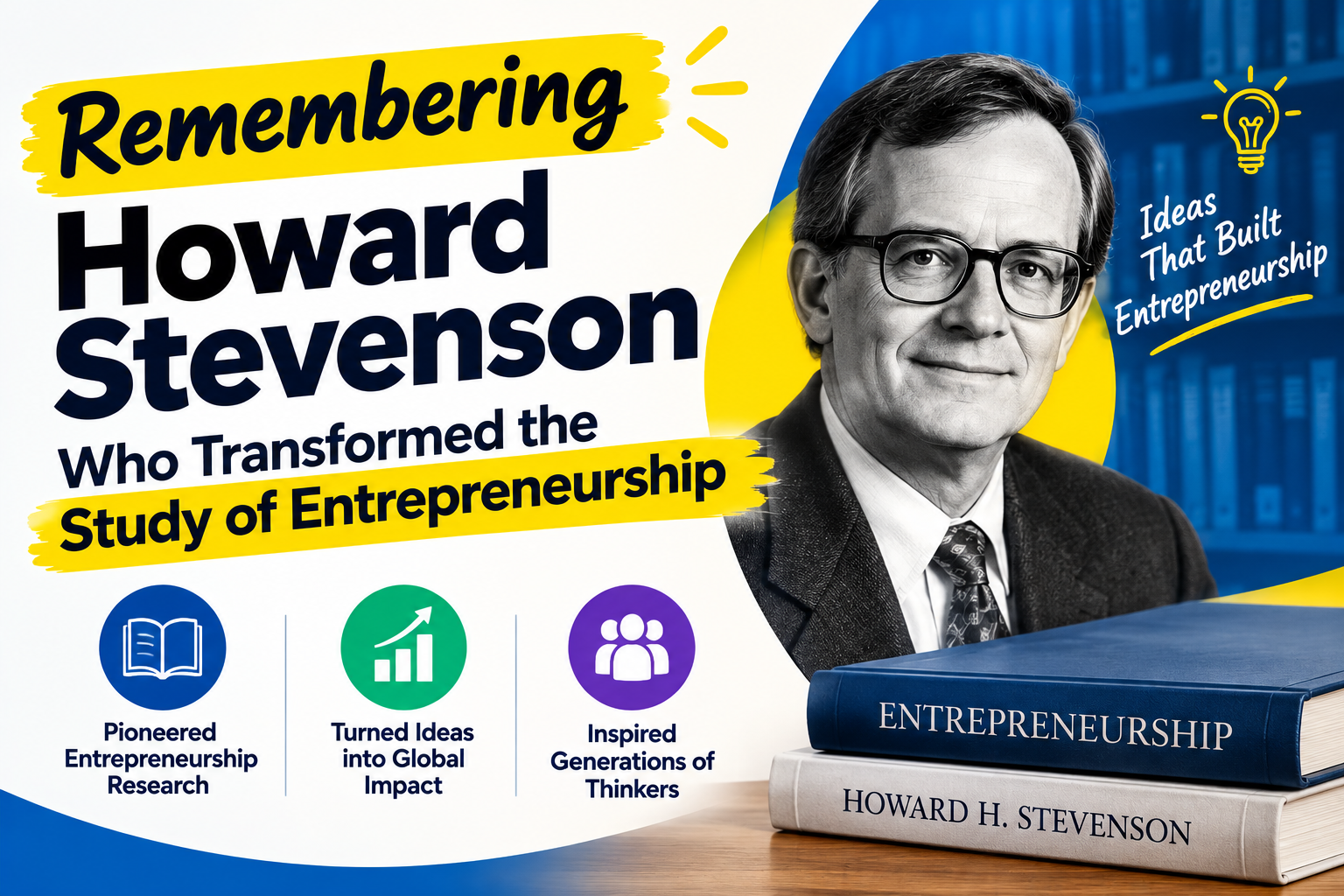
Howard Stevenson: The Scholar Who Transformed Entrepreneurship
In nineteen eighty two, fewer than twenty universities across America taught courses on starting new companies. Today, more than three thousand colleges around the globe teach entrepreneurial courses to millions of students. Much of that global shift traces back to one visionary scholar named Howard Stevenson. His research at Harvard Business School transformed how universities, corporate leaders, and founders think about creating new ventures.
Before his research gained traction, major business schools focused almost entirely on running established corporations. Professors taught students how to manage giant factories, balance complex accounting books, and follow corporate hierarchies. Howard Stevenson challenged that narrow view by proving that starting and growing businesses required a completely distinct set of skills. His contributions gave credibility to a subject that scholars once dismissed as mere luck or salesmanship.
What Is the Study of Entrepreneurship?
The Study of Entrepreneurship focuses on how people spot new opportunities and build organizations to capture them. It examines how founders make decisions under heavy uncertainty when data is limited. Students learn how to test business concepts, raise funding, and guide small teams through rapid growth. This academic field owes its modern structure to the foundational models that Stevenson created during his long academic career.
Prior to his work, many academics believed that founders were simply born with unusual risk taking personalities. Stevenson proved that entrepreneurial behavior is a discipline that anyone can learn and practice. He showed that successful business builders follow specific patterns when allocating capital and hiring talent. His research shifted business education away from personality traits and focused on repeatable management behaviors.
The Famous Entrepreneurship Definition That Changed Business
Howard Stevenson authored the most famous Entrepreneurship Definition in modern business history. He defined entrepreneurship as the pursuit of opportunity beyond resources controlled. This simple sentence changed how scholars and executives viewed venture creation across the globe. It stripped away the idea that you need millions of dollars in the bank before launching a new project.
The first part of the definition highlights the relentless pursuit of valuable opportunities. Entrepreneurs spot unmet customer needs, broken market services, or fresh technological possibilities before others notice them. They move forward with intense focus to solve those problems even when market conditions look uncertain. Action and speed take priority over waiting for perfect market conditions.
The second part emphasizes operating beyond resources currently owned or managed. Traditional managers only pursue projects that fit within their existing corporate budgets and equipment. Entrepreneurs figure out how to borrow, partner, or lease what they need to achieve their vision. This mindset allows lean teams to outmaneuver massive corporations with endless cash reserves.
Howard Stevenson Harvard Legacy and Academic Career
Howard Stevenson Harvard career spanned more than four decades of teaching, writing, and leadership. He joined the faculty at Harvard Business School in nineteen seventy and quickly became a favorite among students. His lively classroom discussions pushed students to think critically about risk, resource allocation, and leadership ethics. He challenged future business leaders to build companies that created lasting value for society.
During his time at Harvard, he served as the Sarofim Rock Professor of Business Administration. He also held key administrative roles, including Senior Associate Dean and Director of External Relations. His tireless advocacy helped secure major funding for business research and faculty development across the university. He established Harvard as the premier global center for entrepreneurial education and research.
Beyond the classroom, Stevenson served on dozens of corporate boards and advised countless startup founders. He practiced what he taught by helping launch successful private companies, real estate funds, and charitable foundations. His practical business background gave his academic writing a grounded sense of realism. Colleagues and students respected him because his ideas produced clear results in the real business world.
Promoter Versus Trustee: Two Contrasting Approaches to Management
Stevenson identified two distinct approaches to business administration, which he labeled the promoter and the trustee. Promoters represent the entrepreneurial mindset, driven entirely by the search for new opportunities. Trustees represent the classic administrative mindset, focused on protecting and optimizing existing resources. Both styles serve valuable purposes, but they operate with completely different priorities.
A promoter constantly asks what market opportunities exist and how the company can seize them quickly. They prefer short commitments of capital so they can change direction whenever market conditions shift. Another perspective comes from the trustee, who asks what resources the company currently owns and how to defend them from competitors. Trustees rely on formal hierarchies, long planning cycles, and heavy layers of risk analysis before making moves.
Companies that rely solely on trustee behavior eventually become slow, bureaucratic, and vulnerable to market disruption. Organizations that balance both approaches can innovate quickly while maintaining financial stability. Stevenson argued that large corporations must adopt promoter habits if they want to survive sudden market changes. His insights laid the groundwork for what modern business leaders now call corporate innovation.
Core Principles of Entrepreneurial Management
Stevenson organized his research into five distinct dimensions that separate entrepreneurial organizations from traditional bureaucracies. These dimensions provide a practical checklist for any business leader seeking greater agility and market responsiveness.
- Strategic orientation driven entirely by rapid opportunity pursuit rather than resource limits
- Fast resource commitment made in stages to minimize capital losses if ideas fail
- Resource control achieved through partnerships, leasing, and outsourcing rather than permanent asset ownership
- Flat organizational structures that encourage direct communication, fast decisions, and high employee autonomy
- Reward systems tied directly to team value creation rather than job titles or office politics
Overcoming Institutional Resistance to Entrepreneurship Education
Introducing entrepreneurship to prestigious universities was not an easy task in the nineteen eighties. Many senior professors viewed business creation as an unworthy academic topic lacking theoretical rigor. They believed that business schools should focus exclusively on training executives for Fortune five hundred corporations. Stevenson faced considerable skepticism from colleagues who doubted that startup success could be taught in a classroom.
He answered critics by publishing rigorous case studies and academic papers backed by extensive field research. His studies documented the exact financial, strategic, and managerial choices made by successful company founders. By providing clear analytical frameworks, he demonstrated that entrepreneurship had solid academic foundations. His persistence gradually convinced faculty members across top universities to embrace the new field.
Today, business schools worldwide compete aggressively to attract top entrepreneurial talent. Campuses feature startup incubators, venture funds, and specialized degree programs dedicated to company creation. That global transformation would have taken decades longer without Stevenson courage and intellectual leadership. His work expanded the mission of business education to serve builders as well as managers.
Lessons on Life, Career, and Measuring True Success
Stevenson believed that professional achievement means very little if it comes at the expense of a fulfilling life. In his acclaimed book titled Just Enough, coauthored with Laura Nash, he explored the true nature of long term satisfaction. He warned ambitious professionals against chasing endless wealth without considering their personal values. Real success requires balancing multiple goals rather than maximizing a single financial number.
He outlined four essential components of lasting satisfaction that every professional should cultivate. Happiness represents the daily joy and pleasure you take in your activities. Achievement reflects the concrete goals you accomplish through hard work and skill. Significance measures your positive impact, while legacy involves building ideas that help others succeed long after you are gone.
Many high achievers fail because they focus entirely on achievement while ignoring the other three components. Stevenson advised his students to set limits on their professional ambitions so they could invest in family, friendships, and community. He lived by these principles, maintaining deep personal relationships and mentoring hundreds of students throughout his life. His wisdom reminded ambitious leaders that true wealth includes character, generosity, and peace of mind.
Mentoring the Next Generation of Founders and Scholars
Colleagues and former students remember Stevenson as an extraordinarily generous teacher and mentor. He made time for anyone who sought his advice, listening patiently to their business ideas and personal concerns. His office door remained open to young scholars, aspiring founders, and university staff members alike. He asked insightful questions that helped people discover their own answers and build self confidence.
His teaching method centered on mutual respect rather than academic arrogance. Instead of lecturing from a stage, he guided students through real dilemmas using the famous Harvard case method. He encouraged diverse viewpoints and taught students to challenge conventional corporate assumptions. Many of his former students went on to create billion dollar enterprises, lead major universities, and fund world changing charities.
His influence extended far beyond the students who sat in his physical classroom. Scholars around the world built upon his research frameworks to study venture capital, social enterprise, and family business. That broad academic network helped spread entrepreneurial education to every continent. Stevenson legacy lives on through every teacher who uses his frameworks and every founder who applies his principles.
Practical Ways to Apply Stevenson Wisdom in Your Business
Founders and executives can apply Stevenson insights immediately to improve their organizational performance. If your employees wait for large budgets before testing ideas, encourage them to find low cost alternatives. Rent equipment, partner with suppliers, or launch minimal prototypes to validate customer interest before spending heavily.
Review your internal approval processes to eliminate unnecessary bureaucratic friction. Give frontline workers the freedom to solve customer problems quickly without waiting for committee sign off. Reward initiative, curiosity, and smart risk taking across every department in your company. Keeping your management structure flat helps your business stay responsive to customer needs.
Focus your strategic planning on solving real customer problems rather than defending existing product lines. When market conditions change, be willing to pivot your resources toward promising new directions. Embracing Stevenson promoter mindset keeps your organization young, energetic, and resilient in competitive markets. Success comes from chasing valuable opportunities with determination and creative resourcefulness.
The Lasting Influence of a Visionary Educator
Howard Stevenson passed away in twenty twenty one, leaving behind an extraordinary intellectual and personal legacy. He transformed entrepreneurship from a neglected topic into one of the most popular fields of study in global education. His famous definition remains the standard reference point for scholars, policymakers, and venture builders worldwide. He proved that entrepreneurial management is an essential skill set for organizations of every size.
His life demonstrated that profound academic scholarship can coexist with practical business success and personal warmth. He showed that true leadership involves lifting others up and creating opportunities for future generations. Business leaders who study his principles gain a timeless framework for building resilient, innovative, and socially responsible enterprises. Howard Stevenson ideas will continue to inspire and guide ambitious builders for decades to come.
Honor His Legacy by Pursuing Opportunity
Howard Stevenson changed business education forever by proving that entrepreneurship is a discipline anyone can learn. His definition of pursuing opportunity beyond controlled resources remains a guiding light for creators around the world. By focusing on customer problems, committing capital in smart stages, and maintaining a promoter mindset, you can build great things regardless of your starting budget.
Take inspiration from Stevenson life and work by examining your own career and business ventures today. Look for big opportunities in your market and find creative ways to test them with the assets you have. Cultivate lasting success by balancing achievement with personal happiness, community impact, and a positive legacy. Start your next venture with bold ambition, clear ethics, and the confidence to pursue opportunities wherever they lead.
About the Author