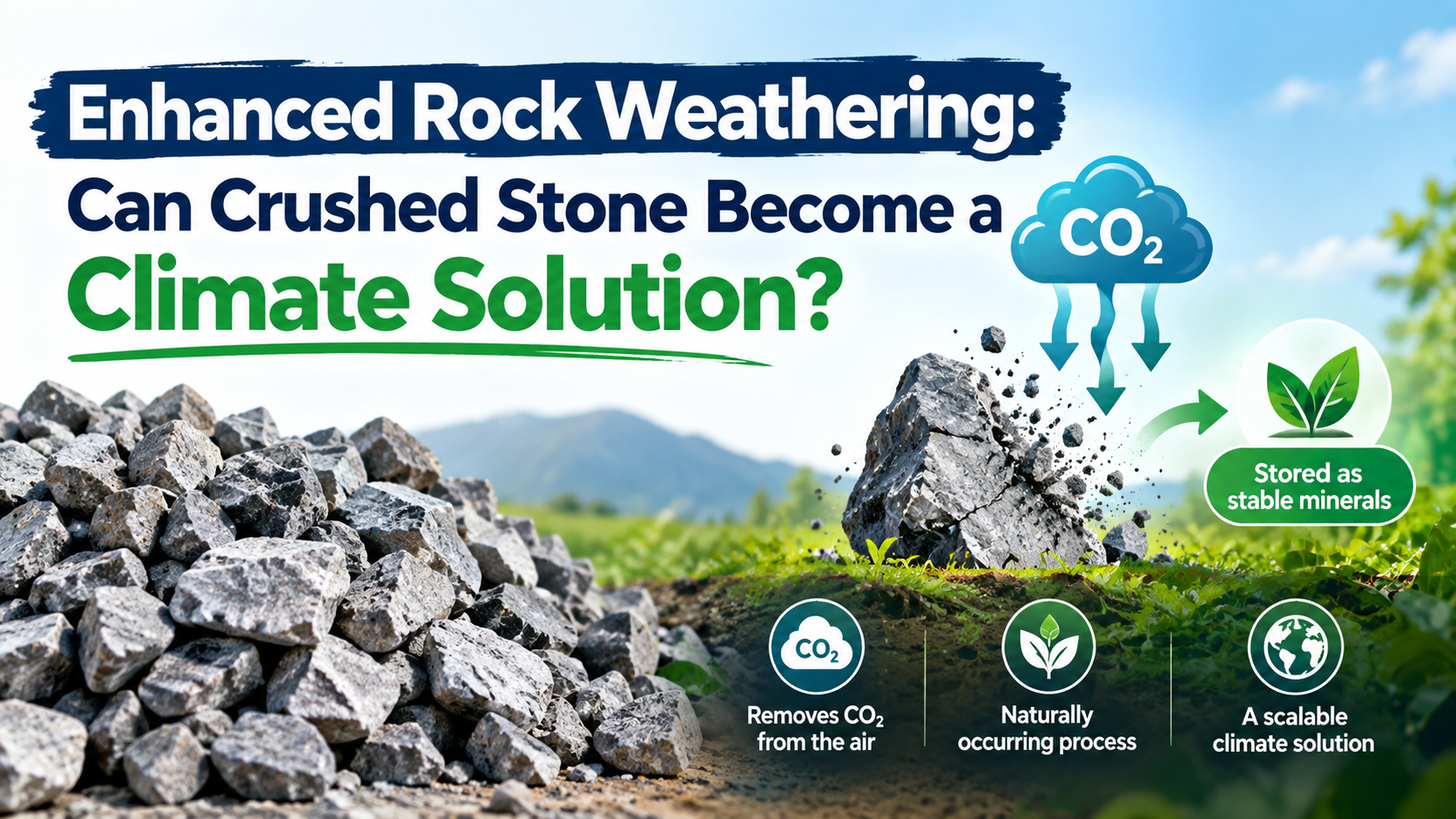
Enhanced Rock Weathering: Can Crushed Stone Become a Climate Solution?
Human activities release more than thirty seven billion metric tons of carbon dioxide into the air every single year. Natural geological processes have always pulled carbon out of the sky, but nature moves at a slow pace across millions of years. Scientists are now testing whether spreading crushed volcanic stone on agricultural fields can speed up this natural chemistry. This method is known as enhanced rock weathering, and it is quickly moving from laboratory test tubes into commercial farmland.
The core concept relies on basic chemistry that has kept our planet habitable for billions of years. When rain falls through the sky, it absorbs carbon dioxide and turns into a very weak acid. That moisture reacts with rocks on the ground, dissolving minerals and locking carbon into dissolved forms. Spreading finely ground rock across millions of farm acres increases the surface area available for these reactions. While the carbon capture potential is significant, critical questions remain about real world durability, energy costs, and measurement accuracy.
What Is Enhanced Rock Weathering?
Enhanced rock weathering is an open environment carbon removal technology based on natural mineral breakdown. In nature, giant mountains slowly weather away over thousands of years as rain washes over exposed stone surfaces. Grinding rocks into a fine powder multiplies the surface area millions of times over. When farmers spread this powder across crop fields, natural mineral reactions happen within weeks instead of centuries.
The primary goal of this practice is permanently trapping atmospheric carbon in a dissolved chemical state. As soil water interacts with crushed silicate minerals, carbon dioxide transforms into dissolved bicarbonate ions. These bicarbonate solutions wash down through drainage systems, enter river networks, and eventually flow out to sea. Once dissolved carbon reaches the ocean, it can remain safely trapped for tens of thousands of years.
Unlike giant industrial air capture machines that require steel pipelines and underground storage caverns, this approach uses existing farm equipment. Tractors and lime spreaders apply the mineral powder directly onto crop fields alongside normal planting routines. This simplicity allows projects to begin without waiting years to build complex industrial facilities.
Accelerating a Natural Geological Process
Natural weathering of rocks controls the long term carbon cycle of the planet. Rainwater absorbs atmospheric carbon dioxide to form carbonic acid in the atmosphere and soil. When this mild acid touches silicate minerals like basalt, chemical dissolution begins. The reaction neutralizes the acid while producing calcium, magnesium, and bicarbonate solutions.
Bringing crushed stone into agricultural soils creates an ideal environment for rapid mineral breakdown. Farm soils contain high concentrations of carbon dioxide generated by plant root respiration and active soil microbes. Constant soil moisture and biological acids speed up the breakdown of mineral grains. The soil essentially acts as a giant chemical reactor powered by natural weather and biological life.
Reaction rates change depending on local climate conditions and soil properties. Warm temperatures and abundant rainfall speed up mineral reactions significantly. Soil acidity, natural organic matter, and crop root depth also influence how fast the rock particles dissolve. A treatment that reacts quickly on a farm in Brazil may react much slower on a farm in Canada.
What Real Field Evidence Shows
Laboratory models have predicted large scale carbon removal for years, but real field data is now emerging. A major four year field trial on a working maize and soybean farm in Illinois provided direct evidence from 2016 to 2020. This study was led by David Beerling from the University of Sheffield and published in 2024. Researchers applied fifty metric tons of crushed basalt per hectare each year to study the real world impacts.
The Illinois study showed impressive agronomic benefits alongside carbon capture. Maize crop yields increased by twelve percent in 2020, while soybean yields rose by sixteen percent in 2019 compared to untreated control plots. The applied basalt reduced soil acidification and boosted overall soil fertility without expensive synthetic inputs. These results proved that crushed volcanic stone can support food production while capturing carbon.
From the loss of calcium and magnesium minerals in the soil, the research team calculated cumulative carbon removal potential. The trial showed a removal potential of ten point five tons of carbon dioxide per hectare over the four year period. This estimate was inferred from mineral breakdown in the soil rather than direct measurement at the ocean outlet. The results followed repeated applications totaling two hundred tons of rock per hectare.
The study also checked for potential toxic heavy metal buildup in the soil and food. Researchers found no significant increase of trace metals in harvested grain or exchangeable soil pools compared to untreated fields. These results showed that using tested basalt under proper management creates safe conditions for food production.
Why Basalt Is the Preferred Rock for Agriculture
Not all rocks are suitable for enhanced rock weathering projects. Basalt is the most widely tested rock type because it is abundant, volcanic, and rich in reactive silicate minerals. It contains high levels of calcium and magnesium, which are the main elements responsible for capturing carbon dioxide. Basalt also contains essential plant nutrients that support biological soil health.
Using basalt avoids many of the environmental hazards linked with other mineral types. Certain ultramafic rocks like peridotite react faster with carbon dioxide, but they often contain high levels of toxic metals like nickel and chromium. Spreading rocks with heavy metal contamination could damage farm soil over time and ruin food crops. Basalt offers a safe balance of fast reactivity and low contamination risk.
Basalt deposits exist in massive quantities across North America, Europe, India, and South America. Many regions already operate basalt quarries to produce aggregate gravel for asphalt roads and concrete buildings. Using existing quarry infrastructure reduces the need to open brand new mining operations.
Agricultural Benefits Beyond Carbon Storage
Farmers must see real productivity gains before they agree to spread tons of rock dust on their private fields. Enhanced rock weathering delivers multiple practical benefits that can improve farm income directly. The slow dissolution of basalt releases vital plant nutrients including calcium, magnesium, potassium, and trace elements into the soil.
Basalt dust acts as a natural soil buffer by raising the pH of acidic fields. Many farmers spend thousands of dollars every year purchasing agricultural limestone to treat acidic soils. Replacing traditional limestone with crushed basalt neutralizes soil acidity while removing carbon instead of releasing it. Traditional limestone releases carbon dioxide when it dissolves, while basalt absorbs carbon dioxide during the reaction.
Healthier soil chemistry helps crop plants build stronger root networks and absorb moisture more effectively. This resilience helps crops survive short droughts and severe heat waves during summer growing seasons. Higher crop yields and reduced fertilizer expenses give farmers strong commercial reasons to adopt rock dust treatments.
How Carbon Moves From Farmland to the Ocean
The journey of captured carbon extends far beyond the agricultural field where the stone is spread. When carbon dioxide turns into dissolved bicarbonate in farm soil, it enters local ground water and field drainage pipes. These drainage waters flow into local streams, enter major river networks, and eventually empty into the sea.
Once bicarbonate reaches the deep ocean, it can remain stable for more than one hundred thousand years. Marine organisms use dissolved calcium and carbonate to build protective shells and coral structures. When these organisms complete their life cycle, their shells settle onto the ocean floor to form solid limestone rock. This marine sedimentation locks carbon away from the atmosphere on geological timescales.
However, calculating carbon capture at the soil surface does not tell the full story. Some dissolved carbon can be released back into the air if water chemistry changes along the way. Water passing through acidic rivers or over hot riverbeds can experience chemical degassing. Scientists must study these downstream water pathways to confirm how much carbon permanently stays in the ocean.
Comparing Carbon Removal Methods
Evaluating climate solutions requires looking at durability, land use, and overall costs. The table below illustrates how enhanced rock weathering compares with other prominent carbon capture approaches.
| Carbon Removal Approach | Storage Lifespan | Main Practical Benefit | Primary Limitation |
|---|---|---|---|
| Enhanced Rock Weathering | 10,000+ Years | Improves crop yields and soil pH | Complex transport and river monitoring |
| Tree Planting Programs | 20 to 100 Years | Enhances wildlife habitat | Vulnerable to forest fires and disease |
| Direct Air Capture Machines | 1,000+ Years | Verifiable closed storage | High capital costs and electric demands |
| Agricultural Biochar | 100 to 1,000 Years | High moisture retention in soil | Requires vast biomass feedstock supplies |
| Soil Organic Carbon | 10 to 50 Years | Low initial setup expense | Carbon can escape when land is plowed |
The Massive Industrial Supply Chain Challenge
Spreading rock dust at a global scale requires moving billions of tons of heavy material every single year. A 2025 United States modeling study led by David Beerling estimated net removal potential of one hundred sixty to three hundred million tons of carbon dioxide annually by 2050. Achieving these projections would require increasing basalt extraction to one or two billion tons per year by 2070.
Moving and processing these vast quantities of stone requires an industrial supply chain. Quarry machinery must excavate the stone, heavy crushers must grind it into dust, and trucks must transport it to farm fields. Every mechanical step consumes energy, burns fuel, and generates carbon emissions. If these industrial machines run on fossil fuels, the net climate benefit drops significantly.
Transport distance between quarries and croplands is the single most critical factor for project success. Hauling heavy rock dust hundreds of miles in diesel trucks burns massive amounts of fuel and raises project costs. Projects must source basalt from local regional quarries located close to agricultural zones. Rail transport and clean electric vehicles will be needed to keep transport emissions low.
Existing mineral residues from mining sites and industrial quarries can supply early projects with ready material. However, the volume of available mine tailings is far too small to support large scale global deployment. In a February 2026 perspective, Marcus Schiedung and his research team concluded that dedicated rock mining appears unavoidable for full scale climate deployment. Building this mining network will require significant capital investment and environmental planning.
Measuring Carbon Removal Accurately Below Ground
Carbon credit markets require clear proof before issuing payments for environmental claims. Verifying carbon removal from enhanced rock weathering is challenging because the chemical reactions occur underground across vast open fields. A 2024 measurement review by Matthew O. Clarkson and colleagues highlighted the technical limits of current measurement tools.
Soil core sampling allows scientists to track the loss of solid calcium and magnesium over time. Water testing can measure the concentration of dissolved bicarbonate ions leaving field drainage tiles. However, natural soil variation, fluctuating rainfall patterns, and complex water movements make precise quantification difficult. Weather events can speed up or delay chemical reactions unpredictably.
Another complication is that soil acids other than carbonic acid can break down rock minerals. Nitric acid from synthetic fertilizers and organic acids from plant roots can dissolve basalt without capturing atmospheric carbon. If a rock dissolves due to fertilizer acids, no atmospheric carbon dioxide is removed from the air. Scientists must separate these different chemical reactions to calculate true carbon removal.
Downstream water chemistry in rivers can also trigger chemical reactions that release gas back into the air. The 2026 perspective by Schiedung described the fate of weathering products in river systems as poorly constrained. Researchers are developing better geochemical models, satellite sensors, and autonomous river monitors to track carbon from farm fields to coastal waters.
Managing Environmental and Health Risks
Large scale application of crushed minerals carries potential environmental risks that demand strict management. A 2024 environmental assessment by Charlotte R. Levy and colleagues outlined critical safety concerns including airborne dust, trace metal accumulation, and water system alterations. Projects must implement strict safety standards to protect farm workers and local ecosystems.
Inhaling fine mineral dust can create serious respiratory health problems for farm workers and local communities. Particles smaller than ten micrometers can penetrate deep into human lungs if handled carelessly. Application equipment must use dust suppression systems, enclosed tractor cabs, and coarse particle sizes to prevent airborne hazards. Spreading damp rock dust on calm days prevents fine powder from drifting into neighboring towns.
Water quality in local streams and rivers must also be monitored continuously. Adding large amounts of dissolved minerals to farm runoff can alter the pH and mineral balance of freshwater habitats. While moderate alkalinity can help counter ocean acidification, rapid chemical shifts might disrupt local freshwater fish and plants. Careful application rates prevent sudden chemical shocks to delicate river ecosystems.
Feedstock purity is critical to avoid contaminating agricultural soils with hazardous heavy metals. Rocks containing elevated levels of nickel, chromium, lead, or arsenic must be excluded from agricultural programs. Regular laboratory testing of every quarry batch ensures that only safe, high grade basalt reaches food producing land.
Economic Realities and Carbon Credit Markets
Enhanced rock weathering projects are expensive to launch, requiring millions of dollars for rock grinding, transport logistics, and geochemical verification. Farmers cannot be expected to pay for these operations out of their own pockets. The business model relies on selling verified carbon removal credits to corporations seeking to offset their greenhouse gas emissions.
Major technology corporations and investment funds are already purchasing advance carbon removal credits from rock weathering startups. These early credit sales provide the upfront cash needed to purchase rock, pay trucking firms, and compensate participating farmers. As carbon credit prices stabilize, rock weathering could become a steady secondary revenue source for rural farming communities.
Fair contracts are essential to build trust between project operators and land managers. Farmers provide the land, run the spreading equipment, and manage the crops. In return, they should receive free mineral fertilizer, improved soil health, and a fair share of the carbon credit revenue. Transparent business partnerships ensure that rural communities benefit directly from the green economy.
Unresolved liability questions must also be settled by insurance markets and government regulators. If a project fails to deliver its predicted carbon removal, or if soil chemistry changes unexpectedly, responsibility must be clearly defined. Clear legal frameworks will protect farmers from financial risks and give credit buyers confidence in their investments.
Regional Potential and Global Opportunities
Tropical regions offer ideal natural conditions for enhanced rock weathering deployment. Warm temperatures and high seasonal rainfall accelerate chemical mineral dissolution rates by several times compared to cold climates. Countries like Brazil, India, and Indonesia possess vast agricultural regions located directly adjacent to volcanic basalt deposits.
Deploying projects in developing nations must follow strict ethical guidelines and community consent protocols. Wealthy global corporations must not treat lower income countries as unregulated testing grounds for experimental technologies. Local farming communities must retain full decision power over their lands and receive direct economic compensation.
Local agronomy institutes and universities should lead regional research and monitoring efforts. Local scientists understand native crop rotations, soil management histories, and unique seasonal weather cycles. Partnering with regional universities builds local scientific capacity and ensures that projects respect local environmental regulations.
Temperate farming regions in North America and Western Europe also offer great potential due to advanced infrastructure. Dense road networks, modern rail systems, and mechanized farm equipment allow for efficient rock distribution. Combining tropical and temperate projects will be necessary to achieve meaningful global carbon removal.
Summary and Call to Action
Enhanced rock weathering offers a practical approach to carbon dioxide removal by turning crushed stone into a natural climate solution. Field trials confirm that spreading basalt dust can raise crop yields, restore soil fertility, and capture carbon for thousands of years. However, scaling this method requires managing huge industrial supply chains, measuring underground reactions accurately, and controlling environmental risks.
Realizing the full potential of this technology demands responsible science, transparent reporting, and clean energy systems. Crushing and moving billions of tons of stone must be done using renewable power and local supply routes. Governments must establish clear safety rules, while researchers continue gathering long term field data from diverse agricultural regions.
Everyone has a role to play in building a balanced, sustainable climate strategy. Follow verified research from independent scientific institutions and stay informed about emerging carbon removal practices. Support agricultural policies that encourage sustainable soil management, cut industrial emissions, and fund responsible carbon removal technologies today.
About the Author