Quantum Computing Explained: How Quantum Computers Work
In twenty nineteen, an experimental quantum processor solved a calculation in two hundred seconds that would take the fastest supercomputer ten thousand years to finish. That experiment showed the world that regular computers have hard limits when dealing with massive data sets. Traditional microchips process information step by step, which slows them down during giant mathematical simulations. Quantum computing offers a completely new way to process calculations using the strange laws of physics.
Regular laptops and phones do an amazing job running video games, streaming movies, and sending messages. Yet when scientists try to model complex molecules or design better batteries, standard computers run out of memory. Quantum machines tackle these impossible calculations by testing millions of possibilities at the same time. This detailed guide breaks down how these powerful machines work and why they matter for the future.
What Is Quantum Computing in Simple Terms?
Quantum Computing Explained begins with the basic rules that govern our physical universe. Classical computers follow standard physics where objects exist in one specific place at one specific time. Quantum computers follow the rules of quantum mechanics, which govern tiny particles like electrons and photons. At this subatomic level, particles can do things that seem impossible in our normal daily experience.
A quantum computer takes advantage of these strange microscopic behaviors to process information at unbelievable speeds. Instead of grinding through math problems one after another, it evaluates huge groups of outcomes simultaneously. This unique ability allows researchers to find solutions to problems that would otherwise take centuries to calculate. It represents a massive upgrade in computational capability rather than just a faster version of your home PC.
Bits Versus Qubits: The Basic Building Blocks
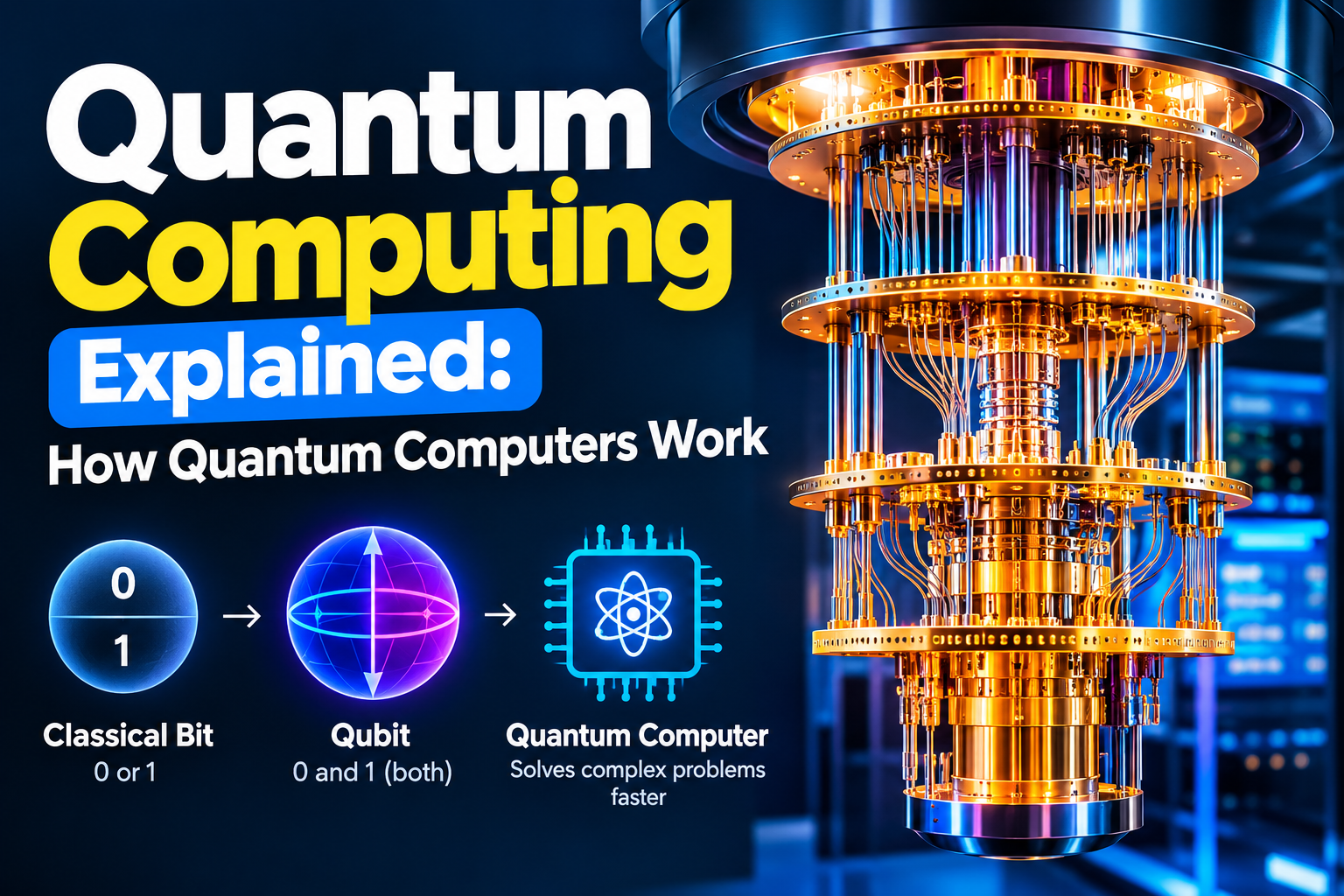
Every regular computer relies on tiny digital switches called bits to store and process data. A standard bit can only exist in one of two positions, represented as either a zero or a one. Every photo you take, video you watch, and website you browse gets converted into long strings of zeros and ones. Your phone processor flips these switches billions of times each second to run applications.
Quantum machines do not use standard bits to process information. They use quantum bits, which scientists call qubits for short. A qubit can represent a zero, a one, or any combination of both states at the exact same moment. This flexible state allows a small group of qubits to store vastly more information than regular silicon bits.
Adding more regular bits to a computer increases its processing power in a straight line. In contrast, adding more qubits increases computing power exponentially with every single additional unit. A machine with only fifty high quality qubits can hold more calculation states than any single supercomputer on earth. This exponential scaling gives quantum hardware its immense computational strength.
Superposition: Being in Two States at Once
The first major principle behind quantum computing is a physical phenomenon called superposition. Think about a regular coin resting flat on a wooden table. The coin must show either heads or tails, representing the fixed state of a standard computer bit. There is no middle ground while the coin lies completely still on the surface.
Now picture spinning that same coin rapidly on the tabletop. While the coin spins, it looks like a blur of both heads and tails at the same time. You cannot declare it heads or tails until you slap your hand down to stop the motion. Superposition works much like that spinning coin, allowing a qubit to explore multiple values simultaneously.
This spinning state lets a quantum system test numerous paths through a complex maze at once. A standard computer must walk down one hallway, hit a dead end, back up, and try the next path. A quantum machine floods the entire maze like water, finding the exit in a single operation. This capability saves enormous amounts of time when searching massive databases.
Entanglement: The Invisible Connection Between Particles
The second essential principle that powers quantum hardware is called entanglement. Albert Einstein famously called this phenomenon spooky action at a distance because it seemed so bizarre. When two qubits become entangled, their physical properties become deeply linked regardless of how far apart they sit. Changing the state of one qubit instantly affects its entangled partner across the processor.
In a standard computer, each bit works independently without knowing what neighboring switches are doing. Entangled qubits work together like a synchronized team of expert musicians playing a song. When one qubit receives new information, all connected qubits update their status immediately. This tight coordination enables quantum processors to share information across calculations instantly.
Entanglement multiplies the problem solving power of the computer with every qubit added to the system. As researchers link dozens of qubits together, the machine can process interconnected equations that classical machines cannot even hold in memory. This linked power is what makes quantum systems so promising for molecular modeling and material science.
Quantum Interference: Finding the Right Answer Fast
Having qubits explore thousands of possibilities at once creates a new challenge: finding the single correct answer. This is where the principle of quantum interference comes into play. Qubits behave like physical waves in water, with crests and troughs that can collide with each other. When waves collide, they can either amplify each other or cancel each other out completely.
Quantum programmers write special mathematical instructions called quantum algorithms to control these waves. The algorithm creates constructive interference to amplify the probability of correct answers. At the same time, it creates destructive interference to cancel out incorrect answers. By the time the calculation finishes, the wrong paths vanish and the correct solution stands out clearly.
This wave control ensures that the computer delivers accurate results without checking every wrong answer manually. It turns computational probability into exact mathematical answers with incredible speed. Mastering interference is the key to writing effective software for modern quantum processors.
What Does a Real Quantum Computer Look Like?
Most people assume a quantum computer looks like a giant black server box or a sleek desktop tower. The reality looks much more like a golden chandelier suspended inside a massive metal cylinder. The visible golden structure is actually a multi stage cooling system called a dilution refrigerator. Layers of copper plates, gold wiring, and silver tubes work together to drop internal temperatures.
The actual quantum processor chip sits at the very bottom of this chandelier structure. This tiny silicon chip must be kept colder than outer space, near absolute zero temperatures. Extreme cold stops subatomic particles from vibrating so they can maintain their delicate quantum states. Even the slightest amount of room heat or electrical static can ruin an active calculation instantly.
Specialized cables run down the frame to deliver precise microwave pulses to the chip. These radio signals manipulate the qubits, flip their states, and read the final answers. Massive helium cooling tanks and vacuum pumps surround the exterior to maintain the ultra cold environment. Operating these machines requires specialized laboratory facilities with clean power and vibration controls.
Key Differences Between Classical and Quantum Systems
Seeing how these two computing technologies compare helps clarify where each system excels:
- Classical computers process data using binary bits that represent fixed zeros or ones, while quantum computers use flexible qubits.
- Regular processors evaluate mathematical operations sequentially one after another, whereas quantum processors evaluate millions of states simultaneously through superposition.
- Standard desktop computers operate reliably at normal room temperatures, but quantum processors require extreme refrigeration near absolute zero.
- Traditional computers are great for word processing, browsing, and streaming, while quantum systems focus on complex molecular simulations and heavy optimization problems.
- Classical software uses standard logical gates like AND and OR, while quantum programs use wave interference and entanglement operations.
Major Scientific Problems Quantum Systems Will Solve
Developing new medical drugs currently takes over ten years and billions of dollars in laboratory testing. Pharmaceutical companies must synthesize thousands of chemical compounds to see how they interact with human proteins. Quantum computers can simulate molecular bonds at the atomic level with complete accuracy. This ability will allow scientists to test millions of virtual drug candidates in days, accelerating life saving cures.
Clean energy technology represents another massive field that will benefit from quantum hardware. Designing longer lasting batteries for electric vehicles requires a deep knowledge of chemical reactions inside battery cells. Quantum simulations will help chemists discover new solid state materials that store more energy safely. Researchers can also invent more efficient solar panels and discover better catalysts to capture carbon emissions from factory smokestacks.
Global logistics networks face massive routing puzzles every single day. Shipping companies must decide how to route cargo ships, delivery trucks, and airplanes while minimizing fuel costs and delays. The number of possible routes grows so large that regular supercomputers cannot find the perfect schedule. Quantum algorithms can solve these vast optimization puzzles in minutes, saving billions of gallons of fuel each year.
How Quantum Technology Affects Digital Encryption and Cybersecurity
Modern online security relies on mathematical encryption to protect passwords, credit card numbers, and banking data. Systems like RSA encryption work because factoring huge prime numbers takes classical computers thousands of years. A powerful quantum computer running a formula known as Shor Algorithm could crack standard encryption in minutes. This potential vulnerability presents a serious challenge for financial networks and government agencies.
Cybersecurity experts are already creating new defensive systems called post quantum cryptography. These new security protocols use complex mathematical problems that even quantum processors cannot break easily. Financial institutions and tech platforms are actively upgrading their systems to adopt these quantum resistant standards today. Preparing early ensures that global internet traffic remains safe from future decryption threats.
Quantum physics also offers a new way to send secure messages called quantum key distribution. If an unauthorized person tries to intercept a quantum communication line, the act of observing alters the qubits instantly. Both the sender and receiver detect the intrusion immediately and discard the compromised key. This technology creates communications that are physically impossible to tap without detection.
Current Hardware Obstacles: Noise, Heat, and Error Rates
Building reliable quantum hardware is one of the hardest engineering challenges in human history. Qubits are extremely fragile and lose their quantum properties when exposed to tiny disturbances. Stray heat, magnetic fields, and background radiation can cause a problem called quantum decoherence. When decoherence occurs, the qubits collapse back into standard zeros and ones, ruining the calculation.
Researchers are developing quantum error correction methods to overcome this physical fragility. Error correction combines multiple physical qubits into a single reliable logical qubit that resists noise. Building these stable systems requires thousands of physical qubits working together perfectly. Achieving high fault tolerance remains the primary technical goal for computer scientists worldwide.
Manufacturing uniform quantum chips also presents serious precision fabrication hurdles. Every single qubit on a silicon wafer must behave identically to its neighbors. Minor microscopic flaws in the chip structure can alter microwave frequencies and introduce math errors. Improving semiconductor fabrication techniques will allow companies to produce chips with lower defect rates.
Who Is Building Quantum Hardware Today?
Major technology giants and agile startups are competing to build the world leading quantum platforms. IBM has deployed dozens of working quantum systems connected to the cloud, allowing students and developers to run real code. Google continues to push the boundaries of quantum supremacy with its custom superconducting processors. Microsoft focuses on topological qubits that aim to build hardware with builtin error protection.
Specialized hardware startups like Rigetti, IonQ, and D Wave are exploring different physical approaches to qubit design. Some use trapped ions held in place by laser beams, while others use photons of light moving through optical circuits. No single technology has won the race yet, and each method has distinct strengths and limitations. This healthy competition between diverse technical approaches accelerates progress across the entire industry.
Research universities and government laboratories play a massive role in basic scientific discoveries. Physicists publish open source code, train new engineers, and explore novel materials for superconducting circuits. Public investments ensure that the foundational science continues to advance steadily alongside commercial ventures. The global quantum ecosystem thrives on this close partnership between academia and private industry.
How to Start Learning Quantum Concepts Today
You do not need a degree in advanced physics to explore quantum computing concepts right now:
- Access free cloud platforms like IBM Quantum Composer to build your own simple quantum circuits online.
- Learn open source programming libraries such as Qiskit, Cirq, or PennyLane using popular Python coding environments.
- Read introductory physics guides and watch university lecture series that explain quantum principles in plain language.
- Join online developer communities and participate in global quantum coding challenges to solve real mathematical puzzles.
- Practice linear algebra and basic matrix math to better comprehend how quantum gates transform qubit data states.
Will Quantum Computers Ever Replace Your Home Laptop?
Many people wonder if quantum processors will eventually replace smartphones, laptops, and desktop gaming rigs. The simple answer is no, because standard computers are already superior for daily personal tasks. You do not need subatomic superposition to stream videos, write school essays, or send text messages. Regular silicon microchips perform everyday tasks with incredible speed, low cost, and minimal power consumption.
Quantum computers will primarily operate inside secure cloud data centers alongside massive supercomputers. Everyday consumers will benefit from quantum processing indirectly through better medicines, improved batteries, and smarter delivery systems. When your phone app needs to solve an impossible logistics puzzle, it will query a cloud quantum computer in the background. Hybrid computing networks will combine the unique strengths of both architectures seamlessly.
Your personal devices will continue to use classic silicon microchips with enhanced neural processing units. These personal devices will handle user interfaces, local media, and basic software tasks efficiently. Quantum machines will remain specialized tools reserved for heavy mathematical and scientific research. This collaborative setup gives society the best advantages of both computing technologies.
The Timeline Ahead for Practical Quantum Systems
The quantum computing industry is moving rapidly from laboratory experiments toward commercial utility. Over the next five years, hardware makers plan to release processors with thousands of physical qubits. Improved error mitigation software will allow these machines to deliver useful answers to complex chemical questions. Early commercial value will appear in materials design, specialty chemicals, and financial risk analysis.
By the twenty thirties, fault tolerant systems with millions of physical qubits will begin to emerge. These advanced machines will tackle complex molecular simulations that revolutionize healthcare and environmental sustainability. Quantum computers will work alongside artificial intelligence models to analyze massive scientific data sets. The combination of smart algorithms and quantum speed will accelerate discovery across every branch of science.
Long term progress depends on training a new generation of software developers, engineers, and scientists. Educational programs are expanding rapidly to teach quantum programming concepts to high school and college students. As the developer pool expands, more innovative applications will emerge for quantum hardware. The coming decade will prove to be an exciting era of computational discovery.
Embrace the Future of Advanced Computing
Quantum Computing Explained reveals a massive shift in how humans process complex information. By tapping into the natural laws of subatomic physics, quantum processors solve problems once thought impossible. From lifesaving pharmaceuticals to green energy breakthroughs, this technology promises profound benefits for our global society.
While true commercial fault tolerance remains a work in progress, the foundational tools exist today. You can log onto cloud quantum platforms right now to write your first program and test real quantum circuits. Explore open educational resources, follow industry breakthroughs, and start building your quantum knowledge today. The computational tools of tomorrow are waiting for curious minds to explore them.
About the Author