AI Employees vs Human Employees: 7 Key Differences and What It Means for Your Business in 2026
Introduction: AI Employees vs Human Employees — The Shift Is Real
Work is changing fast. For decades, companies hired people to do tasks. Now a new type of worker is joining teams. AI employees that act, not just answer.
Surveys show that 40 percent of large enterprises now scale AI agents, up from 27 percent last year. These digital workers handle support tickets, process invoices, draft code, and book meetings without constant human prompts. This is not science fiction. It is happening in 2026.
This article compares AI employees vs human employees. You will see 7 key differences, real use cases, and what this means for your business as digital workforces emerge.
What Are AI Employees and How Do They Work?
AI employees are autonomous software agents that pursue goals with little human help. They plan steps, use tools, and complete tasks end to end. Unlike chatbots that wait for prompts, AI employees act on their own.
An AI employee might read an email, check a database, update a record, and send a reply. It loops through observe, decide, act, and learn until the job is done. It can work across email, CRM, calendars, and other systems.
Think of AI employees as junior staff who never sleep. They handle repetitive, rule based work so humans can focus on judgment and strategy. This is the core of how digital workforces are emerging.
7 Key Differences Between AI Employees and Human Employees
Understanding AI employees vs human employees starts with clear contrasts.
1. Speed and scale
AI employees work 24/7 without breaks. They can handle thousands of tasks in parallel. Humans need rest and can only do so much at once.
2. Cost structure
AI employees cost a fraction of human salaries. A single agent may cost 500 to 2000 dollars per month. A human worker costs 3000 to 8000 dollars or more per month in most markets.
3. Consistency and errors
AI employees follow rules precisely. They do not get tired or distracted. Humans make more mistakes on repetitive tasks, especially under pressure.
4. Creativity and judgment
Humans excel at creative work, complex decisions, and empathy. AI employees struggle with nuance, ethics, and unstructured problems. This is where humans still lead.
5. Training and onboarding
AI employees can be deployed in days or weeks. Humans need weeks or months of training. AI scales faster when demand spikes.
6. Emotional intelligence
Humans read tone, build trust, and handle sensitive talks. AI employees are improving but still lack real empathy. Customer facing roles still need humans for tough cases.
7. Accountability and oversight
Humans take responsibility for outcomes. AI employees need guardrails and human review. Companies must set clear rules and audit logs for AI work.
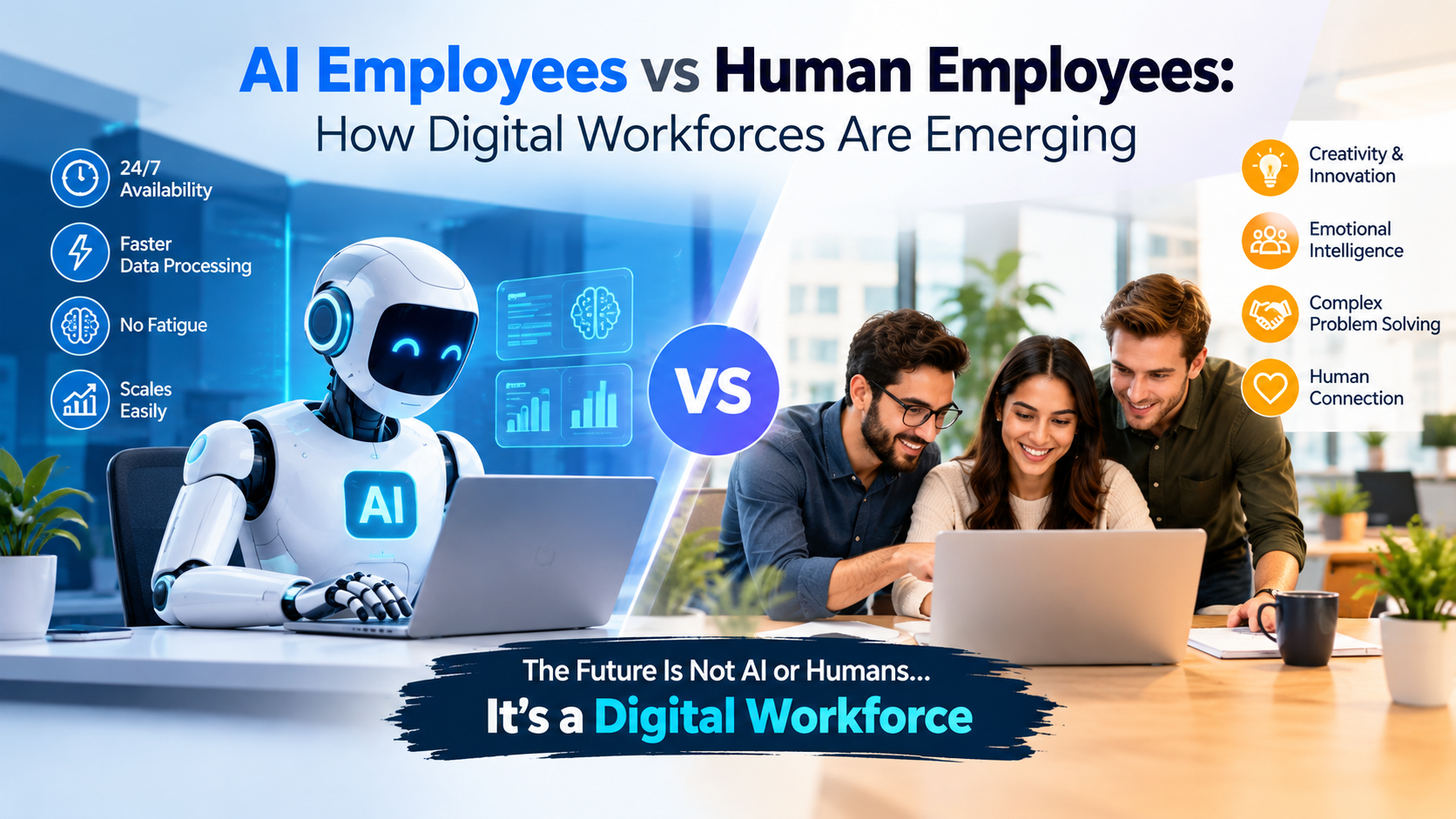
These differences show why AI employees vs human employees is not about replacement. It is about pairing strengths.
Where AI Employees Are Winning in 2026
AI employees are taking over specific tasks where they have clear advantages.
Customer support tier one
AI employees read tickets, check order status, process refunds within rules, and update customers. Human agents step in only for complex or emotional cases. This cuts queue times and frees humans for high value work.
Sales development
AI employees research leads, enrich CRM records, and send personalized outreach. They book meetings when prospects reply positively. Sales reps focus on closing deals, not prospecting.
Finance and operations
AI employees match invoices to purchase orders, flag mismatches, and post entries. They reduce manual queues and speed up month end close. This improves accuracy and audit trails.
Software development
AI employees draft code changes, run tests, and open pull requests. Senior engineers review and merge. This cuts time on routine tasks and lets humans focus on architecture.
Data and reporting
AI employees pull data from multiple sources, clean it, and generate reports. They answer questions like which products drove margin last quarter with charts and summaries.
These wins show a pattern. AI employees handle repetitive, multi step work. Humans handle judgment, exceptions, and strategy. This is how digital workforces are emerging in real companies.
Where Human Employees Still Lead
AI employees are powerful, but humans still lead in key areas.
Creative work
Writing brand stories, designing campaigns, and crafting visuals need human taste. AI can draft, but humans set direction and final quality.
Complex decisions
Strategy, pricing, hiring, and partnerships need judgment and context. AI can provide data, but humans make the call.
Empathy and trust
Sensitive customer talks, conflict resolution, and coaching need real empathy. AI employees can assist, but humans build deep trust.
Ethics and compliance
High stakes decisions in legal, medical, or financial areas need human oversight. AI can prepare drafts, but humans sign off.
Leadership and culture
Building teams, setting vision, and shaping culture are human jobs. AI employees do not inspire or lead people.
These areas show why AI employees vs human employees is about collaboration. Humans focus on what they do best. AI handles the rest.
Cost and ROI: AI Employees vs Human Employees
Money matters when comparing AI employees vs human employees.
AI employee costs
A typical AI employee costs 500 to 2000 dollars per month depending on tasks and tools. Some platforms charge per task or per seat. Total cost is still far below a human salary.
Human employee costs
A junior worker costs 3000 to 8000 dollars per month in most markets. Senior staff cost 8000 to 15000 dollars or more. Add benefits, taxes, and training, and costs rise further.
ROI timeline
Median payback time on AI employee deployments is about 5 months. Sales agents pay back in around 3 months. Finance and ops agents in about 9 months. Humans take longer to train and reach full output.
Scalability
You can add more AI employees fast during peaks like holiday sales. Hiring and training humans takes weeks or months. AI scales easier for short term surges.
These numbers show why companies are adding AI employees fast. The math works for many repetitive roles.
Risks and Limits of AI Employees
AI employees are not perfect. Knowing limits helps you avoid problems.
Wrong actions
AI employees can update the wrong record or send a message to the wrong person if rules or data are poor. Guardrails and review steps reduce this risk.
Over automation
If an edge case appears, AI employees may fail or loop. Design handoff points to humans for exceptions.
Security and privacy
AI employees that access many systems can expose data if not controlled. Use least privilege access and audit logs.
Job shifts
Some repetitive roles will shrink. Companies should retrain staff for oversight, exception handling, and higher value work.
Trust gaps
Customers and staff may not fully trust AI employees at first. Clear communication and human backup build confidence over time.
AI employees work best when they support people, not replace them. This is key as digital workforces emerge.
How to Start With AI Employees in Your Business
You do not need a big program to begin. A small, focused pilot works best.
Pick one workflow
Choose a repetitive, rule based, high volume task. Examples include support ticket triage, invoice matching, or lead enrichment.
Define success clearly
Set metrics like time saved, error rate, or tickets resolved without human touch. This makes it easy to judge results.
Choose a simple AI employee platform
Many tools now offer prebuilt AI employees for common tasks. Start with one that fits your workflow and integrates with your stack.
Run a controlled pilot
Limit the AI employee to a subset of cases or users. Monitor outputs and fix issues before scaling.
Expand based on results
If the pilot hits targets, add more cases or workflows. Train your team on oversight and exception handling.
Start small, prove value, then grow. This is the smart way to compare AI employees vs human employees in your own business.
What This Means for Workers and Careers
AI employees will change many jobs, but not eliminate the need for people.
Routine tasks shift to AI
Data entry, basic triage, and standard reports will be automated first. This frees humans from busywork.
Human roles move to oversight
Workers will review AI outputs, handle edge cases, and make judgment calls. This is higher value work.
New skills matter
Prompt design, AI oversight, and workflow mapping will become common skills across roles. Learning these boosts your value.
Career growth favors AI savvy workers
People who can design, monitor, and improve AI workflows will gain value. This is the future of work as digital workforces emerge.
The goal is not to replace workers. It is to remove busywork so people can focus on work that needs a human touch.
The Future of Work: AI and Human Teams Side by Side
AI employees will keep improving and spreading.
More prebuilt AI employees will appear for common tasks in support, sales, finance, and HR. This will lower the barrier for small teams.
Better safety and control features will reduce risks. Expect clearer audit logs, approval steps, and rollback options.
Deeper integrations with existing software will make AI employees easier to deploy. They will live inside tools you already use, like CRM, helpdesk, and ERP.
Multi agent systems will coordinate complex workflows. One AI employee may handle research, another execution, and another quality checks.
The core idea stays the same. AI employees handle routine work. Humans handle judgment, creativity, and leadership. This is how digital workforces are emerging in 2026 and beyond.
Conclusion: AI Employees vs Human Employees — Build Smart Teams Now
AI employees vs human employees is not a battle. It is a chance to build smarter teams. AI employees handle repetitive, multi step work. Humans handle judgment, creativity, and trust.
Businesses that adopt AI employees gain speed, lower costs, and better data. Workers gain relief from busywork and can focus on higher value work. The shift is already underway in support, sales, finance, and development.
Take action if you lead a team or function. Pick one repetitive workflow. Test an AI employee on a small scale. Measure results and learn. The teams that start now will build a strong advantage in 2026 and beyond. This is how digital workforces are emerging, and you can be part of it.
About the Author