AI Agent vs Chatbot: What's the Difference and Which Should Businesses Use?
Introduction: Why This Choice Matters Now
Many businesses now use AI to talk to customers and handle routine work. Surveys show that a large share of customer chats can be solved by bots without a human. At the same time, new AI agents can do full tasks on their own, like updating records or placing orders.
This creates a real question for business owners and managers. Should you use a simple chatbot, or invest in a more advanced AI agent? The right pick can save time and money. The wrong pick can waste both.
This article explains the difference between an AI agent and a chatbot in plain language. It shows where each tool shines and which one your business should use in 2026.
What Is a Chatbot?
A chatbot is a program that talks with people through text or voice. It waits for a user message, then gives a reply. Most chatbots follow set rules or scripts. Some use basic AI to understand different ways of asking the same question.
Rule based chatbots match keywords to fixed answers. If a question falls outside the script, the bot often gets stuck or hands the chat to a human. AI powered chatbots can handle more varied language, but they still focus on giving answers, not doing work.
Chatbots are common on websites, messaging apps, and support pages. They answer FAQs, share store hours, track orders, or collect basic details before a human takes over. Their main job is conversation, not action.
What Is an AI Agent?
An AI agent is a smarter, more independent type of AI system. It does not just reply to messages. It can plan steps, use tools, and take actions to reach a goal with little human help.
For example, an AI agent can:
- Read a customer request.
- Check data in your CRM or order system.
- Decide what needs to be done.
- Update records, send emails, or create tickets on its own.
- Keep working until the task is done or it needs human help.
AI agents can remember context across chats and tasks. They can connect to many systems like email, calendars, payment tools, and databases. Their focus is on completing work, not just having a nice conversation.
Core Differences Between AI Agent and Chatbot
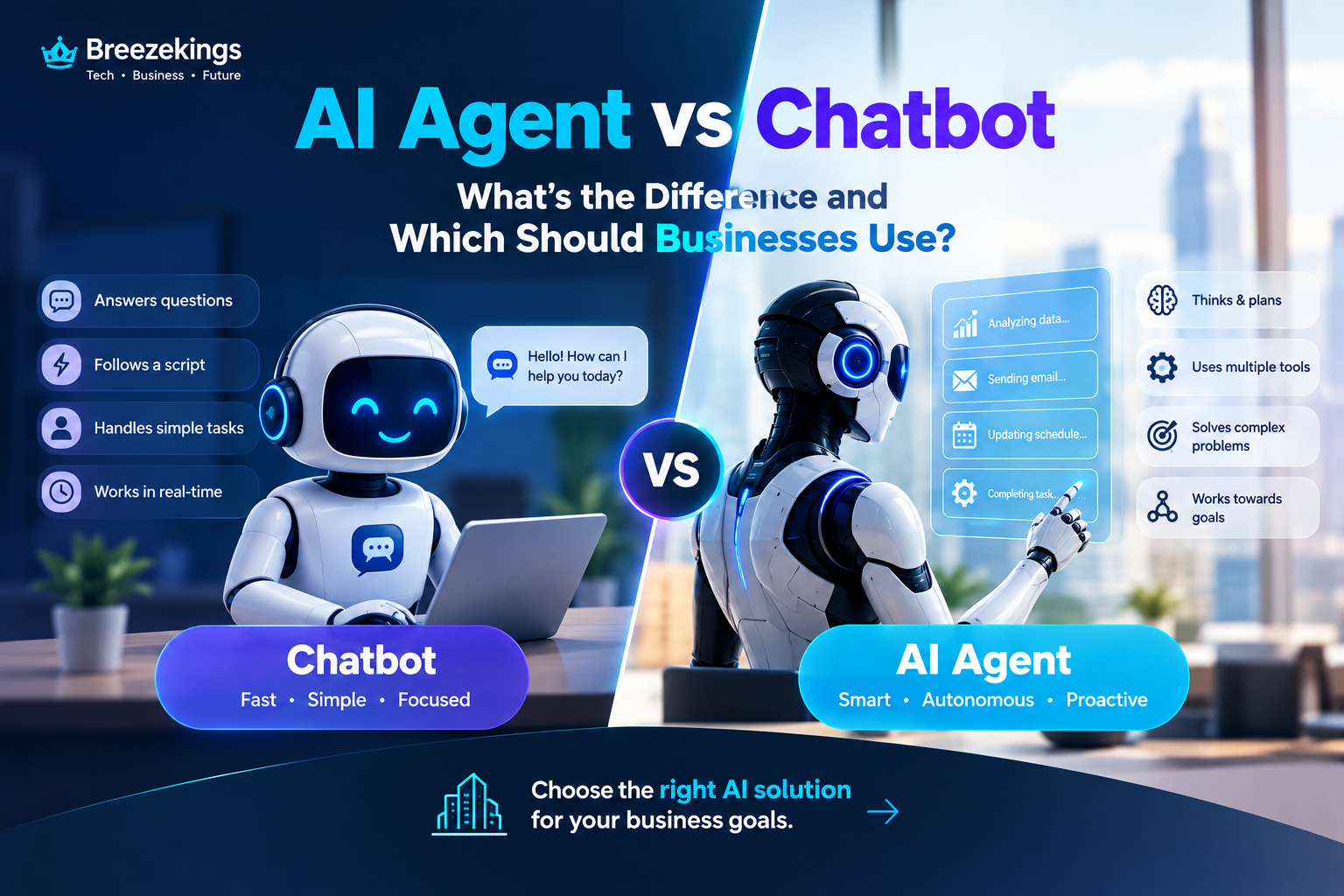
The gap between AI agent vs chatbot comes down to action versus talk. A chatbot responds when prompted. An AI agent acts to reach a goal.
A chatbot usually:
- Waits for a user to start the chat.
- Pulls answers from a set list or knowledge base.
- Stays inside a single conversation window.
- Stops when the chat ends.
An AI agent usually:
- Can start work from a trigger, like a new form or email.
- Reasons across multiple systems and data sources.
- Plans and runs multi step tasks on its own.
- Keeps state and context across sessions and tools.
Think of a chatbot as a helpful receptionist who answers questions. Think of an AI agent as a junior employee who can also do the work behind the scenes.
When a Chatbot Is Enough for Your Business
Many small and mid size businesses do not need a full AI agent right away. A chatbot can be a strong first step if your needs are simple.
A chatbot works well when you want to:
- Answer common questions like pricing, hours, or policies.
- Guide users through a fixed process, like booking a demo.
- Collect contact details before a sales or support call.
- Reduce the number of basic chats that reach your team.
Chatbots are usually faster and cheaper to set up. They fit well on websites, WhatsApp, or social media inboxes. If most of your requests are repetitive and clear, a chatbot can cut response time and free your staff for harder tasks.
When You Need an AI Agent Instead
An AI agent becomes valuable when your work involves many steps and systems. It helps when you want the AI to do real tasks, not just talk about them.
Consider an AI agent if you need to:
- Process orders, refunds, or changes across your backend.
- Update customer records in your CRM after each chat.
- Create and assign support tickets without manual work.
- Run follow up sequences like emails, reminders, or checks.
- Handle complex requests that need data from several places.
AI agents shine in sales, support, and operations where work flows across tools. They can turn a single customer message into a full workflow that runs to completion. This reduces manual steps and speeds up results.
Real World Use Cases for Each Tool
Seeing concrete examples makes the AI agent vs chatbot choice clearer.
Chatbot use cases:
- A retail site uses a chatbot to answer questions about shipping times and return rules.
- A clinic uses a chatbot to share opening hours and collect patient details before a call.
- A SaaS company uses a chatbot to qualify leads and book demos on the calendar.
AI agent use cases:
- A support team uses an AI agent to read incoming emails, check order status, and send refunds when rules are met.
- A sales team uses an AI agent to research leads, update the CRM, and send personalized follow ups.
- An operations team uses an AI agent to monitor stock levels, create purchase orders, and alert managers when thresholds are crossed.
In each case, chatbots handle conversation. AI agents handle full pieces of work.
Cost, Setup Time, and Skills Needed
Cost and effort matter when you choose between AI agent vs chatbot. Chatbots are usually lighter to launch. AI agents need more planning and integration.
Chatbots:
- Often available as plug and play widgets or simple platforms.
- Can be set up in days or weeks with basic content and rules.
- Need someone to write answers, flows, and handoff rules.
- Work with limited integrations in many cases.
AI agents:
- Often need connections to your CRM, email, ticketing, or ERP systems.
- Require clear goals, rules, and safety checks for autonomous actions.
- May need help from IT or an AI partner for setup and testing.
- Take longer to launch but can replace more manual work over time.
Start with a chatbot if you want quick wins with low risk. Move to an AI agent when you are ready to automate real workflows and have the data and systems in place.
Risks and Limits to Keep in Mind
Both tools have limits. Knowing them helps you avoid bad surprises.
Chatbot limits:
- Struggles with questions outside its scripts or training.
- Can frustrate users if it cannot handle complex issues.
- May hand off too many chats to humans if not well designed.
AI agent limits:
- Can make wrong decisions if rules or data are poor.
- Needs strong guardrails to prevent unwanted actions.
- Requires monitoring and review, especially at the start.
Good design, clear rules, and human oversight reduce these risks for both chatbots and AI agents. Start small, test with real users, and expand as you gain trust in the system.
How to Choose: AI Agent vs Chatbot for Your Business
Use this simple checklist to decide between AI agent vs chatbot.
- If your main goal is to answer FAQs and collect leads, start with a chatbot.
- If you want to cut manual work across systems, lean toward an AI agent.
- If your team is small and your processes are simple, a chatbot may be enough for now.
- If you already use tools like CRM, helpdesk, or ERP and want them to talk to AI, an AI agent fits better.
You can also use both. A chatbot can handle front line chats. When a request needs real work, it can pass the task to an AI agent behind the scenes. This layered approach gives you speed and power.
Future Proofing Your Choice
AI tools are improving fast. What looks advanced today may become standard tomorrow. Still, the core difference stays the same. Chatbots focus on conversation. AI agents focus on action.
When you pick a tool, check if it can grow with you. Can your chatbot add more AI features later? Can your AI agent handle more systems and tasks as you scale? Choose platforms that allow upgrades instead of full replacements.
This way, you protect your investment and avoid starting from scratch in a year.
Conclusion: Pick the Tool That Matches Your Goals
AI agent vs chatbot is not about which one is better in general. It is about which one fits your business needs right now. Chatbots are great for fast, low cost answers and lead capture. AI agents are better when you want to automate real work across your tools.
If you run a small business with simple questions, start with a chatbot. If you run a growing business with complex workflows, plan for an AI agent. Many companies will use both in a smart mix.
Review your top customer requests and internal tasks. Map which ones are simple answers and which ones are multi step jobs. Then choose the tool that matches each job.
Take action this week. List your top five use cases. Match each one to chatbot or AI agent. Then pick a platform and run a small pilot. The right choice will save your team time and give your customers faster, smoother service.
About the Author