Space Force orbital warship carrier: Fortresses of the Final Frontier
For centuries, naval dominance has been projected from the decks of mighty aircraft carriers—mobile sovereign bases that bring power projection to the farthest shores. Now, the United States Space Force is adapting this timeless concept for the theater of outer space. In a bid to secure its assets in an increasingly contested domain, the Space Force is partnering with a private aerospace startup to develop what is being dubbed the “orbital carrier”.
This ambitious project aims to create a new class of warship: a maneuverable platform permanently stationed in orbit, capable of housing and rapidly deploying smaller satellites to respond to threats, conduct surveillance, or replace disabled assets in mere hours.
A “Pre-Positioned Launch Pad” in Orbit
The concept, while sounding like science fiction, is grounded in a very practical military need: speed. Currently, replacing a destroyed or malfunctioning satellite is a logistical nightmare. It requires months or years of preparation, ground-based rocket launches that are constrained by schedules, weather, and the high cost of propellant.
The orbital carrier aims to bypass these limitations entirely. In March 2025, Seattle-based aerospace company Gravitics announced it had secured a contract worth up to $60 million from SpaceWERX—the Space Force’s innovation arm—to develop and demonstrate the vehicle.
Colin Doughan, CEO of Gravitics, described the project as a “game-changer,” explaining that the carrier would act as a “pre-positioned launch pad in space.” He noted that this approach bypasses traditional launch constraints, enabling space vehicle operators to rapidly select a deployment orbit on demand. Instead of waiting for a rocket to launch from Earth, the carrier would simply “open its doors” and release its onboard vehicles to their required positions.
Why the Urgency? The Threat of “Space Dogfighting”
The strategic imperative for such a system comes from evolving threats. The US military has observed other nations, particularly China, developing capabilities that could turn space into a combat zone. General Michael Guetlein, Vice Chief of Space Operations, recently highlighted exercises where Chinese spacecraft demonstrated synchronized maneuvering in orbit—a capability he bluntly described as “dogfighting in space” .
Adversaries are developing anti-satellite (ASAT) weapons, directed-energy devices, and sophisticated jammers designed to blind or disable the US constellation of communications, GPS, and spy satellites. In a conflict, losing these assets could paralyze the US military, which relies on them for everything from drone strikes to infantry navigation.
The orbital carrier serves as a form of insurance. By having a “warehouse” of ready-to-deploy satellites already in orbit, the US could rapidly reconstitute a damaged network. Furthermore, the carrier itself could be a weapon platform, designed with interfaces for mounting offensive or defensive systems, allowing it to release hunter-killer satellites to intercept hostile spacecraft.
Design and Capabilities
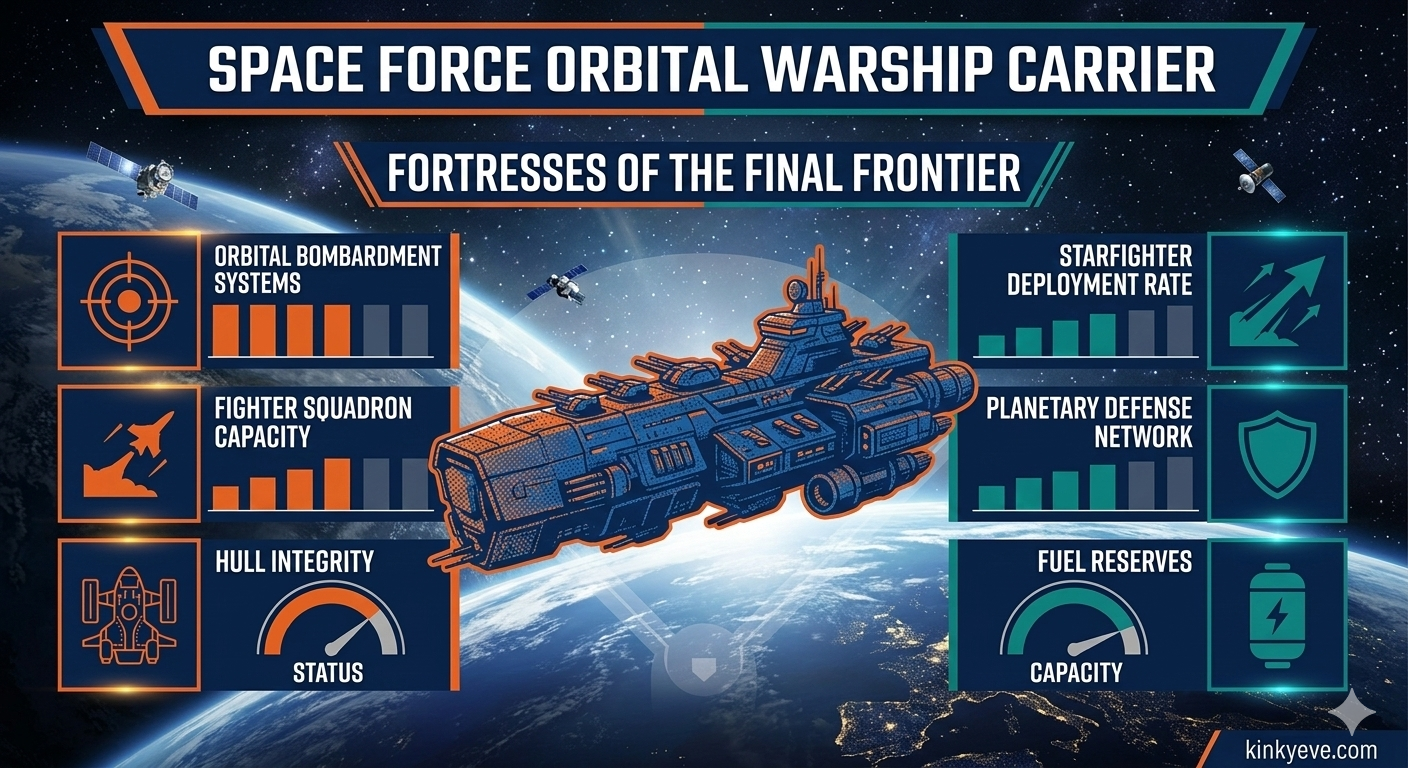
While many specifics remain classified, enough details have emerged to paint a picture of the Orbital Carrier’s potential. Concept art depicts a large, cylindrical or satellite-shaped vehicle with a substantial internal bay. Reports suggest it could have a volume of approximately 2,100 cubic feet and the capacity to haul over 22,000 pounds of cargo and satellites.
This bay is not just for storage; it is designed to be a protective hangar. It shields the smaller “space vehicles” from the extreme thermal conditions and radiation of space, preserving their delicate electronics and solar panels until they are needed. Once a command is given, the carrier can release these vehicles, which are likely maneuverable “tugs” or specialized mission satellites.
The timeline for this project is aggressive. Some reports indicate that a demonstration launch could be ready as early as 2026.
The Harsh Realities of a Space Carrier
Despite the fanfare, the engineering and financial hurdles are immense. Unlike a naval carrier that can be built in a dry dock and floated, an orbital carrier cannot be launched in one piece. It will likely require multiple heavy-lift launches to send the components into orbit, where they would need to be assembled by robots or astronauts—similar to the construction of the International Space Station.
This assembly process would cost billions of dollars. Furthermore, to be an effective warship, the carrier must be mobile. To reposition itself to avoid attack or to reach a new theater of operations, it would need a powerful propulsion system. Analysts suggest this might require Nuclear Thermal Propulsion (NTP) to achieve the necessary efficiency and delta-v (change in velocity). While more efficient than chemical rockets, placing a nuclear reactor on a military platform introduces significant political and safety complexities.
A New Frontier or a New Arms Race?
The international reaction to the orbital carrier has been swift and critical. Chinese military analysts have warned that the program poses a “serious threat to space security,” arguing that it will intensify military competition and turn space into a battlefield. There are concerns that because the carrier could just as easily deploy weapons as satellites, it introduces a dangerous level of opacity into space activities. Other nations may feel compelled to develop their own countermeasures, leading to an escalatory arms race in orbit .
Even within the US, the project is viewed with a mix of awe and caution. A Space Force spokesperson defended the program, stating that the US must retain its leadership in space to secure the nation’s interests and ensure control of a domain critical to the entire Joint Force .
The Orbital Carrier represents a philosophical shift from viewing space as a sanctuary to treating it as a warfighting domain. Whether it becomes a 21st-century reality or a proof-of-concept that is ultimately deemed too expensive or provocative, it signals that the era of uncontested, peaceful spaceflight is giving way to a future where the high ground must be fortified.
About the Author