Agentic AI Explained: How AI Is Moving From Answers to Actions
Introduction: The Next Big Shift in AI Is Already Here
The Next Big Shift in AI Is Already Here
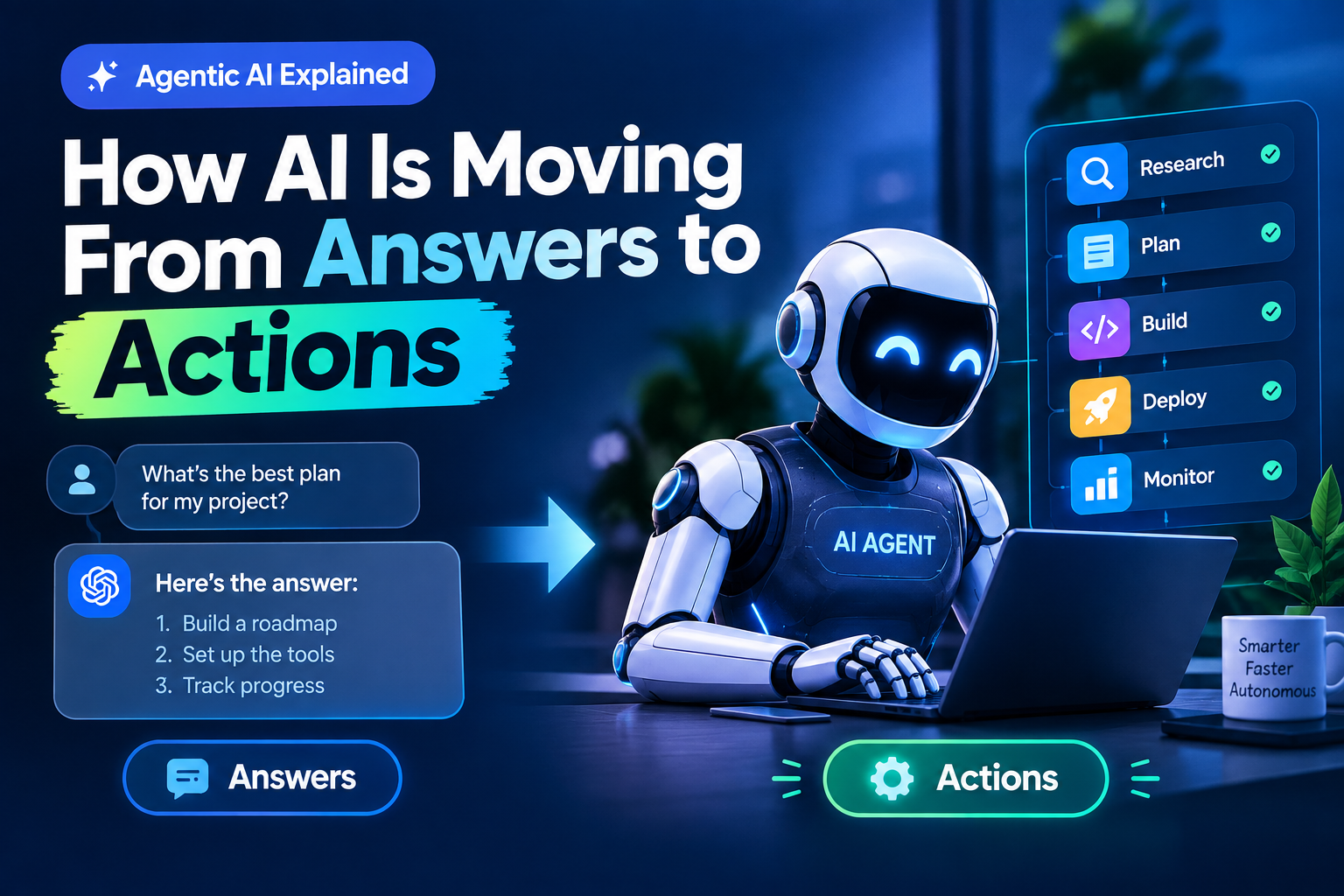
Artificial intelligence is changing fast. For years, most AI tools gave answers. You asked a question, and the AI replied with text or an image. This was useful, but limited.
Now a new wave is taking hold. Agentic AI does not just answer. It acts. It plans steps, uses tools, and completes tasks with little human help. Surveys show that 40 percent of large enterprises now scale AI agents, up from 27 percent last year.
This shift from answers to actions will change how we work, shop, and run businesses. This article explains agentic AI in simple terms. You will see what it is, how it works, and where it is used in 2026.
What Is Agentic AI?
Agentic AI is artificial intelligence that pursues goals on its own. Instead of waiting for a new prompt at each step, it plans a sequence of actions and carries them out.
A standard AI chatbot takes a prompt and returns text. An agentic AI system takes an objective and works through whatever steps are needed to achieve it. It can call APIs, edit files, browse the web, run code, and adjust based on results.
Think of it like this. A chatbot is a smart assistant who answers questions. An AI agent is a junior employee who can also do the work.
How Agentic AI Differs From Traditional AI and Chatbots
The gap is clear once you compare core jobs.
Traditional AI and chatbots focus on answers. They respond to a single prompt with a single output. Their job ends when they send the reply.
Agentic AI focuses on actions. It sets a goal, plans steps, calls real tools, watches what happens, and adjusts. It loops until the task is done.
For example, a chatbot can tell you how to book a meeting. An AI agent can check calendars, propose times, send invites, and confirm the booking without you touching each step.
This shift matters because most real work involves many steps across many tools. Agentic AI is built for that.
How Agentic AI Works: The Basic Loop
Agentic AI follows a simple loop to get things done.
Observe: The agent reads the goal and checks the current state. It may look at emails, databases, or web pages to gather context.
Decide: The agent plans the next step. It chooses which tool to use, like a calendar API, a code editor, or a search engine.
Act: The agent takes the action. It sends an email, updates a record, runs a script, or books a slot.
Learn: The agent checks the result. If the step succeeded, it moves to the next one. If it failed, it adjusts and tries again.
This loop repeats until the goal is met or the agent needs human help. The process is transparent when designed well, so users can see what the agent did and why.
7 Real Examples of Agentic AI in 2026
Agentic AI is not a theory. Companies already use it in production.
1. Customer support agents handle tier one tickets end to end. They read the request, check order status, process refunds within rules, and update the customer. Human agents step in only for complex cases.
2. Sales development agents research leads, enrich CRM records, and send personalized outreach. They book meetings when prospects reply positively. Sales reps focus on closing deals.
3. Finance and ops agents match invoices to purchase orders, flag mismatches, and post entries. They reduce manual queues and speed up month end close.
4. Coding agents draft code changes, run tests, and open pull requests. Senior engineers review and merge. This cuts time on routine tasks and lets humans focus on architecture.
5. Data analysis agents pull data from multiple sources, clean it, and generate reports. They answer questions like which products drove margin last quarter with charts and summaries.
6. HR onboarding agents create accounts, assign training, and schedule orientation for new hires. They coordinate across IT, payroll, and managers without manual handoffs.
7. Marketing content agents draft blog posts, social captions, and ad copy based on briefs. They publish to CMS or schedule posts after human approval.
These examples show a pattern. Agents handle repetitive, multi step work. Humans handle judgment, exceptions, and strategy.
Why Businesses Are Adopting Agentic AI Fast
Adoption is rising because the value is clear and fast.
Speed to value is strong. Median payback time on agent deployments is about 5 months. Sales agents pay back in around 3 months. Finance and ops agents in about 9 months.
Labor relief is real. Many teams face backlogs in support, finance, and data work. Agents reduce queue times and free staff for higher value tasks.
Better data and consistency come from automated workflows. Agents follow rules and log every step. This improves audit trails and reduces human error.
Scalability is easier with agents. You can add more agent capacity without hiring and training. This helps during peaks like holiday sales or month end.
Large enterprises lead adoption, but mid market firms are growing fast. Tools are becoming easier to deploy, which opens the door for smaller teams.
Where Agentic AI Works Best
Not every task fits an agent. Some work needs deep human judgment or creativity. Agents shine in specific areas.
Rule based workflows with clear steps and outcomes. Examples include invoice processing, order changes, and compliance checks.
High volume, repetitive tasks that drain time. Examples include ticket triage, data entry, and report generation.
Multi system processes that move data between tools. Examples include onboarding a customer across CRM, billing, and support platforms.
Time sensitive operations with SLA pressure. Examples include claims triage, incident response, and appointment scheduling.
If a task is messy, unstructured, or high stakes, keep a human in the loop. Use agents to prepare drafts, gather data, or handle routine parts.
Risks and Limits of Agentic AI
Agents are powerful, but not perfect. Knowing the limits helps you avoid problems.
Wrong actions can happen if rules or data are poor. An agent might update the wrong record or send a message to the wrong person. Guardrails and review steps reduce this risk.
Over automation can make processes rigid. If an edge case appears, the agent may fail or loop. Design handoff points to humans for exceptions.
Security and privacy need attention. Agents that access many systems can expose data if not controlled. Use least privilege access and audit logs.
Job shifts are real. Some repetitive roles will shrink. Companies should retrain staff for oversight, exception handling, and higher value work.
Agentic AI works best when it supports people, not replaces them.
How to Start With Agentic AI in Your Business
You do not need a big program to begin. A small, focused pilot works best.
Pick one workflow that is repetitive, rule based, and high volume. Examples include support ticket triage, invoice matching, or lead enrichment.
Define success clearly. Set metrics like time saved, error rate, or tickets resolved without human touch. This makes it easy to judge results.
Choose a simple agent platform. Many tools now offer prebuilt agents for common tasks. Start with one that fits your workflow and integrates with your stack.
Run a controlled pilot. Limit the agent to a subset of cases or users. Monitor outputs and fix issues before scaling.
Expand based on results. If the pilot hits targets, add more cases or workflows. Train your team on oversight and exception handling.
Start small, prove value, then grow.
What This Means for Workers and Careers
Agentic AI will change many jobs, but not eliminate the need for people.
Routine tasks will shift to agents. Data entry, basic triage, and standard reports will be automated first.
Human roles will move to oversight, exceptions, and strategy. Workers will review agent outputs, handle edge cases, and make judgment calls.
New skills will matter. Prompt design, agent oversight, and workflow mapping will become common skills across roles.
Career growth will favor those who learn to work with agents. People who can design, monitor, and improve agent workflows will gain value.
The goal is not to replace workers. It is to remove busywork so people can focus on work that needs a human touch.
The Future of Agentic AI: What to Expect Next
Agentic AI will keep improving and spreading.
More prebuilt agents will appear for common tasks in support, sales, finance, and HR. This will lower the barrier for small teams.
Better safety and control features will reduce risks. Expect clearer audit logs, approval steps, and rollback options.
Deeper integrations with existing software will make agents easier to deploy. Agents will live inside tools you already use, like CRM, helpdesk, and ERP.
Multi agent systems will coordinate complex workflows. One agent may handle research, another execution, and another quality checks.
The core idea stays the same. AI that acts, not just answers. The tools will get smarter, safer, and more common.
Conclusion: From Answers to Actions, the AI Shift Is Real
Agentic AI explained in simple terms is AI that acts. It plans steps, uses tools, and completes tasks with little human help. This is a clear move from answers to actions.
Businesses that adopt agents gain speed, lower costs, and better data. Workers gain relief from repetitive tasks and can focus on higher value work. The shift is already underway in support, sales, finance, and development.
Take action if you lead a team or function. Pick one repetitive workflow. Test an agent on a small scale. Measure results and learn. The teams that start now will build a strong advantage in 2026 and beyond.
About the Author